Search This Blog

Showing posts with label teaching. Show all posts

Sunday, 3 May 2015

hats off to missionary moms

During the past two years, I've had the chance to observe an interesting group of people: missionary moms. I realize that they are all different, but there are certain patterns and characteristics that put these women in a league of their own. 

To be honest, I initially found missionary moms to be a scary group. Last year I was a brand new teacher, fresh out of university, and although my parent/teacher interactions were very positive, it was still a source of insecurity. There was a particular brand of parent known to be feisty: missionary moms. You could often expect direct questions, honest impressions, and a distinct feeling that you weren't completely trusted when one of these ladies sat across the table from you. 

But over the past two years, I've grown to admire this group of women. Their husbands are often the ones who inspire a lot of praise -- pilots, doctors, pastors, directors, Bible school professors. (Although, make no mistake, I've met a lot of professional missionary moms, too -- from doctors to reverends.) But behind these men are women who are busy steering the ship of their families, protecting and watching and nurturing. 

The reason I found these moms so scary is the same reason that I admire them: they're a feisty bunch. They don't play games. When they meet a young new teacher, why should they trust them? Their kids have probably had new teachers dozens of times, and they are protective over their children's education. 

There are several moms who have fought to be able to adopt kids and teenagers, and then constantly fight to bring those kids up to speed academically.  

There's a mom who made a commute of one hour every day in horrible Kampala traffic to get her kids to Heritage, because she knew the kids loved the school and that it was good for them to connect with others. 

There are moms who learn how to drive here. Period. (Something I still can't imagine doing.) 

There are moms who camp with their children for several months in the summer while they travel and fundraise for their mission. 

There was a mom who accidentally hit a boda, found her vehicle surrounded by a mob and dozens of boda drivers, who had to lock her doors and pray while driving straight to the police station. 

There are moms who send me messages or meet me in person asking for advice, the concern for their child whose friend has moved or who is preparing to return to the States etched on their faces. Like moms of all teenagers, they sometimes can't get information out of their kids but want to know that they are okay. 

There are moms who drop their kids off at university and then return to their post on the other side of the world, trying to send care packages or arrange a place for them to stay over Easter. 

There are moms who choose to work outside the home, trying to decide on the best child care option in a foreign culture. 

There are moms who choose to stay home with young children, which can be isolating and difficult in one's own country, never mind a new place. 

There's a mom who posted that her husband, a pilot, will be gone on assignment for one month. She wrote that this is "where they shine" -- she loves to hold down the fort while he is away doing ministry! 

For some moms, accepting a particular post means that they need to figure out how to homeschool their children. 

There are moms who run cooking classes or job skills training out of their homes. 

There are plenty of moms who live abroad with special needs children (biological or adopted). They are constantly smoothing out the path for these kids, making sure that they get what they need. 

There are moms who walk to the market and barter for their family's groceries. 

There are many moms who fight the corrupt electricity company tooth and nail! 

There are moms who kill rats, shrieking with terror, while their husbands are away.

There are moms who pack the birthday candles and banners a year in advance, to make sure that their child will have a special day. 

There was a mom who had to comfort her child, watching them have nightmares and anxiety, because of the riots and upheaval they had witnessed during an election. 

There are moms here who have a very strange sense of humor. So-called 'funny' anecdotes include -- "Remember that time we were bathing the boys and little worms popped out of their heads that had been buried in their scalps?" Or -- "One time we were in a village in Tanzania. Two [of seven!] kids were sick, and we had to use a bucket because it wasn't safe to go outside. They were puking and having diarrhea in the same bucket!" 

Every mom seems to know how to cut hair (is that included in missionary training?). 

I've learned that the moms seem to be the ones who know the ins and outs of international medical insurance. 

There are moms here who really know how to stretch a shilling to keep their families healthy and happy.

There are moms who sneak a mini Christmas tree into their luggage to give their kids a small taste of home when the holidays arrive. 

There are moms here who have to explain what Wal-Mart is to their six-year-old, realizing with a start that their child is separated from their own home culture. 

There are moms who have to return to their home country alone, for months at a time, to receive medical treatment for a disease contracted here. 

There are moms who give birth here in Uganda and raise babies far away from friends and family. 


And the stories I hear from the kids! 

"Yes, one time robbers threw poisoned meat over our wall and our dogs died." 

"Once I was bit by a snake." 

"Here's some photos of when we lived in Chad..." And I see the family standing, surrounded by desert, with their daughters who were so ... little

When the kids share stories, I have to wonder about how the mother felt who was on the other side of that experience. 

I've come to view missionary moms with admiration, a bit of awe, and a touch of questioning their sanity. Sometimes I find them intimidating, as I don't often see a chink in their armor. If I don't hear it from them, I often hear about their humanity and their struggles from their kids.

"When we first moved here, my mom cried all the time." 

"After we left the last place we lived, and came to Uganda, my mom felt really lonely." 

They are human. They can be lonely or depressed. They battle inner fears, not just external challenges. I can tell by the way some of my students talk that their mother is the strongest presence in their lives, and her ups and downs are the thermometer for the whole family. 

Missionary moms are often accustomed to people walking in and out of their lives. This second year of teaching, I've been able to build on the foundation from last year. I've forged new friendships and, once their trust is earned, I've discovered that missionary moms can be the greatest encouragers. They are beautiful and godly, but they aren't passive or merely "nice." They are strong and tenacious, relentless in the pursuit of their call to missions and their responsibility to their families. 

So ... hats off to missionary moms! 


Friday, 27 March 2015

the exciting life of a missionary

As I scroll through my Facebook timeline and my old blog posts, I realize that my life often looks ... strangely interesting. Now, of course everybody's life looks more interesting on Facebook. When we scroll through newsfeeds, we all forget that every post means someone was hunched over staring at a screen.

Documenting the mundane: *someone* (who will remain nameless)
 cannot seem to get the clothes IN the basket. 
But I live in Uganda, and most of my friends do not. On top of that, we recently became "official PAOC missionaries" when we felt we should stay in Uganda after my husband finished his degree (not the original plan!). So, through Facebook and blogs and newsletters, we do paint a picture of life here for people who are back home. Even more intimidating, we strive to send honest "dispatches from the mission field" to people who now support us as missionaries.

Last summer when we visited Canada, I was caught off guard when a few people asked brightly, "So, how was your trip?"

My... trip?

"Where is your tan?!"

Uh ... I work in a classroom every day. It's really not ... Well, it's not that exciting.

I'm afraid there has been some miscommunication, and I'm afraid that a lot of it is my fault. Pictures of exotic birds and monkeys and landscapes can paint a life full of adventure and non-stop novelty. Photos of ministries or volunteering opportunities, along with moving stories, can -- although honest and accurate -- cause people to think that I feel rewarded every day, tangibly "changing" something, seeing an end result.

So I thought I'd describe an average day of whirlwind missions in an exotic location:

5:50 am: Alarm goes off. Fumble for phone, press snooze as quickly as possible.

6:30 am: Stop pressing snooze, get out of bed. Groan to find a crispy dead cockroach by my feet. Scoop it up with toilet paper, wishing Isaac was not in the village all week long so that he could perform his duty of insect control.

Eat something -- anything -- for breakfast. A muffin, a piece of toast, an apple, or a few scoops of yogurt.

Make coffee or tea, fill thermos. Boil water while brushing teeth as not to waste a precious minute.

Student projects -- Medieval manors! 
7:10 - 7:15: Leave the house. As it's wet season, this usually means throwing sandals in my backpack, putting on rubber boots, a jacket and grabbing an umbrella.

7:30: Arrive at school.

Reviewing auditions and making up the cast list for the school musical. 
Spend the day teaching --  giving devotions, prepping, grading, answering emails, calling parents, meeting with the secondary principal, meeting with my professional learning community of other teachers, meeting with student support services, meeting with parents, attending assemblies, writing report card comments, presenting lessons, giving detentions, planning field trips, creating rubrics, stapling things on a bulletin board, refereeing student arguments over the direction of the fan, etc., etc. Common annoyances include printer not working, photocopier backed up, Internet not working, or power going off.

12:10: Lunch. Once a week, it's my turn to get the lunches for the detention room.  That really breaks up the routine and keeps me on my toes.

More teaching.

Special days at school -- Wacky Day! 
3:00: Bell rings. "Stack your chairs, stack your chairs! See you tomorrow. Sam, did you give me that assignment? Whose bag is this? Hey, whose bag? Bye, having a good night!"

Staff meeting, possibly. Or a rehearsal for the school play. This includes running lines with students, listening to students sing the musical numbers, and giving my opinion on costumes made out of margarine containers, cereal boxes and expert use of a glue gun.

4:45 - 5:30: Grading, prepping for the next day.

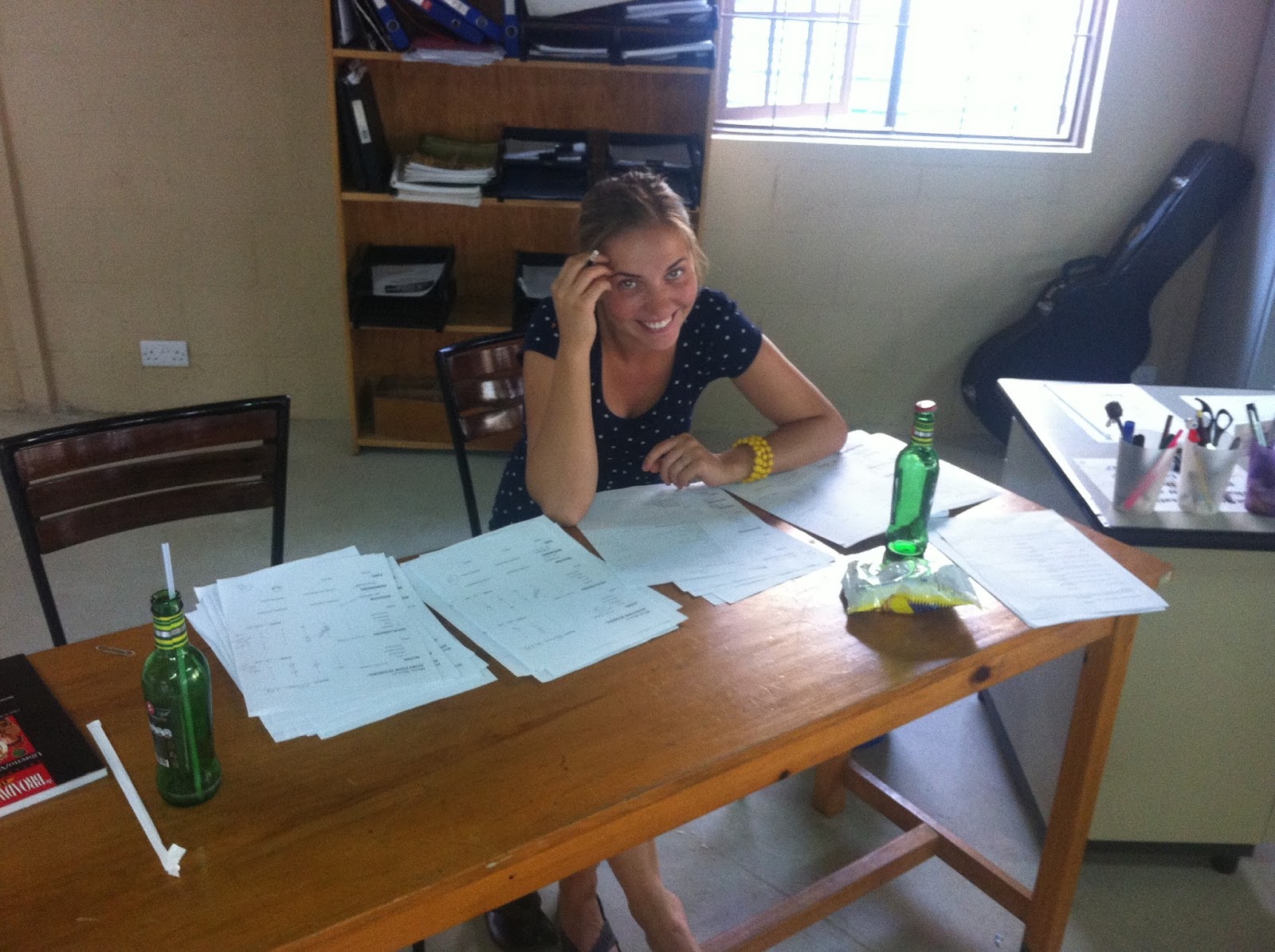
Muwala interfering with a Saturday marking session ... 
5:30: Arrive back home. Feed the cat. Eat a patched-together dinner for one while watching a show. Lately, that show has been Call the Midwife, thanks to an understanding friend who sent me several seasons on a flash drive with my parents when they visited. Isaac and I often like to watch funny sitcoms when he's home, a fact that someone back in Canada found very surprising and, well, a little shallow. To be there. In Uganda. Watching TV?.... Sorry to disappoint.

Scrolling through Facebook, Pinterest and blogs ... Reading ... Sometimes grading *yech*

7:30: Turn on water heater.

8:00: Shower.

8:30: Call Isaac. Have deep conversations about paying the water bill and, could you pick up cat food and almond extract on your way home this weekend?

9:00: Lights out, bed. As much as I wish I was a more efficient human being, I need my sleep.

Once a week this routine is disrupted by attending our couples' Bible study (which, ironically, only I attend now as Isaac is in the village all week). This means I'm either going to eat at someone else's house, or hosting 25 people at my house. Sometimes I take a walk in the evening to pick up a few groceries, eyeing stray dogs warily and avoiding getting hit by bodas. About once or twice a week I hang out with one of my friends, either at her place or mine -- and my friends laugh at how I politely kick them out or politely begin to leave promptly around 8. I'm very clear -- I need my sleep. School night bedtime is not negotiable for this teacher.

This is not to complain. This is not to bore you (sorry). I love my job, I love teaching. I love teaching missionary kids and Ugandan kids that I believe will have a great influence in the future. I love supporting missionary families -- MAF pilots, orphanage directors, Bible school professors, church planters. Sometimes I feel a little restless to be out "on the front lines," sometimes I envy Isaac's life in the village (which, let me tell you, is also full of un-exciting hours -- hence his developed obsession with birdwatching), but I really feel that right now I am where God wants me to be. I believe that what I'm doing is building the Kingdom of God.

I'm sure many of you can relate -- whether your calling at the moment is raising kids or cooking at a church camp (why does that one spring to mind, I wonder?) or working at a bank or standing at a cash register or teaching at a college or cleaning people's teeth or setting up chairs before youth group. There's always the hum-drum of daily life, the mundane tasks that no one includes in a newsletter.

And it's the same over here, across the ocean in Uganda.


But sometimes the day-to-day is where I find the sweetest gems <3 


Tuesday, 11 February 2014

spirit speak through

... even when you are in the middle of teaching a grade 8 English lesson. We're reading through The Diary of Anne Frank, the play. It's the hot season in Uganda; the fan is whirring, the kids are more restless than usual.

A hand goes up at the back of the class. An ESL student, who probably needs yet another clarification on the lesson you are teaching -- the 8 stages of genocide -- or who will shrug and say the maddening phrase: "I don't get it."

"Yes?" [Bracing myself for answering the same question for the fifth time.]

"What happens to men who rape girls?"

I'm surprised. The other students are listening and suddenly quiet. She fills the silence: "I mean, do they burn in hell? Like, forever? Why does it keep happening all the time? It seems like God isn't doing anything about it."

Huh.

Now, what did my education instructor say about this one? It never came up in student teaching. 

"Well..." I begin slowly. This girl is a refugee. She has been to hell and back. I don't know her full story, and the students know even less than I do. They don't fully understand what she is asking.

Suddenly, bumper sticker theology and pat Christian phrases don't seem to cut it.

"Well, I don't know."

I don't know? Aren't those the words a teacher isn't supposed to say? 

"The only thing I know that God will bring about judgment and somehow make things right. I don't know exactly what that will look like. I can only trust that the Bible says God's justice is perfect. Somehow he'll take our broken, messed up world and judge perfectly."

I look down, toy with a paper on my desk. "You know, I get angry about that kind of stuff. Sometimes I feel like I'm not supposed to be angry, that it's not godly or right for a Christian to be angry. But open the Bible -- God is angry about injustice, oppression. It's not wrong to feel angry. Looking at these things in history, looking at the Holocaust, it makes you wonder where God is."

 I suddenly recall one of CS Lewis' responses.

"God is responsible for our freedom, but he can't be held responsible for our choices. And maybe ..." [here comes Amy Carmichael kicking in] "Maybe the very things that we ask God to do something about are the things that we should be doing something about. We are the hands and feet, the body of Christ."

And finally, admitting:

"This will come up later in the unit as we learn about the Holocaust. There are people a lot smarter than me who have grappled with these questions, and I want to bring you the best resources that I can."

I didn't expect that question. Right now, this week, I can't stand that class because they're driving me batty and I'm handing out detentions right and left. Yet that moment was a reminder of why I'm a teacher, the moments that truly matter and the moments that students will remember. I felt in over my head, but also felt that I was being supported and lifted by the Holy Spirit. And maybe even if I messed up the exact words, the Spirit still got through: God is real, God loves you, God heals you, God is just. You trust him with anything, you can ask him anything.

funny things

As much as I want to tear my hair out some days, I can't help but enjoy my students. I haven't taught long enough to have a "favourite" age, but while the middle school years have rightfully earned their reputation for being a little crazy, there is something special about them, too. My students are half-child, open with their emotions and asking ridiculous questions. They're half-adult, too, awkwardly figuring out who they are and how they fit in, sometimes pretending that they know it all and sometimes admitting that they are in unfamiliar territory.

Along the way, they say some funny things.

Right now the features of middle school seem to magnified as we are doing a series of chapels (we have chapel every Wednesday) where boys and girls are divided and we talk about sex, puberty, relationships, etc. Anonymous questions were filled out on cards, and as teachers we are going from there. Unfortunately we assumed that the grade 6 class had learned "the basics" in grade 5. When I casually mentioned this to the grade 5 teacher at the photocopying machine she turned to me with a confused look on her face.  When we investigated further, we realized that, no, "the basics" are covered in science class later this quarter. Chapels should be interesting as we are starting from scratch!

After the first chapel one the grade 6 boys came into my class and asked: "Miss, were you weird when you were a girl in grade 6?"
Me: "Yeah, I probably was ... How was the boys' chapel?"
Him: [dramatically clutching his chest and sinking to the ground] "Good-bye, childhood!"

The grade 8 students were a little annoyed at having the grade 6 students in the same group as them for discussions. I told them they had a choice: they could be lame and check out and put a damper on it for everybody, or they could step up and be leaders. I have to say, the grade 8 girls really did step up in our discussion time.
But I didn't realize grade 6 also had concerns ...
Grade 6 boy: "Why are we all in one group? They've got us grade six kids in there with gorillas who have to shave twice a day!"

The science teacher was informed that the grade 6 students had not yet learned the basics, so he proceeded to begin the "healthy body" unit. After one of the first classes, where he got into the basic mechanics of reproduction, a boy at the back of the class said: "Hey, Mr. Costley, I think I've seen dogs do that thing you're talking about!"
Mr. Costley: "Yup, maybe..."
Boy: [with a look of sudden realization] "My mom said they were playing tag!"

And one last student quote that has nothing to do with chapel, but is very much about English class:
Me: "Give me an example of a metaphor."
Ugandan student: "You're the beans to my posho!"

You know you teach in Uganda when ...

Thursday, 14 November 2013

north american history according to middle schoolers

In my grade 7 World Geography class, we are just finishing our unit on Canada and the United States (Mexico gets lumped into the "Latin America" unit).

This morning over breakfast I marked my students' unit tests. I had to laugh at some of the answers given.


  • "Before the Europeans arrived in North America, native life was pretty much built on nature and wildlife. They made clothing out of animal skins and used bones or elephant tusks to make weapons." 
  • (Earlier in the unit, when presenting an immigration ad for Alaska, a student said, "All tribes are welcome in Alaska!" You can tell you're teaching in Africa when... students refer to elephants and tribalism!) 
  • "Canada helped aid the US while the US fought in France to win the Cold War." 
  • "Difference between Canada and the States: Canada has a smaller population. This is because Americans made lots of posters to attract many people." 
  • "Similarity/Difference: Canada has less people than America. Fact: Almost or about less than 1 million. Similarity/Difference: More people in America. Fact: Over 1 million people." 
  • And one poor girl's chart on similarities and differences in America vs. Canada: 
    • "Canada continued in the slave trade. The US stopped slaved wanted Canada to stop to. Fact: Caused World War I." 
    • "Canada wanted to get independence. The US never wanted Canada to get independence. Fact: Caused World War I." 
    • "Population in Canada was less due to slaves running away. Fact: Less workers. Population in the US grew due to the slaves coming to their free country. Fact: High taxes."
Huh? 

I smile, shake my head, but if I think about it too long it gets a little depressing. Is this really how their brains are filtering what I'm saying at the front of the room? Thankfully, despite these funny errors, almost all the kids did really well on the test. I must have done something right .... right? 

Sunday, 10 November 2013

middle school retreat

Last week was a short week. Instead of spending Thursday and Friday in class, middle school students and teachers went on a one-night getaway to a hotel on Lake Victoria. It was great to get out of the city, enjoy the cool breezes off the lake, and spend time with students in a different context.

Some highlights:


  • Getting my own room. Now, I love Ms. Sinclair, the math teacher, but we were both pleasantly surprised when, after arriving at the resort, rooms were bumped around and we suddenly found ourselves with two separate rooms. 
  • Sleeping on real pillows, with real blankets, on a real double bed. At home in Kansanga, Isaac and I sleep on a "Ugandan double" which is really a generous twin-sized bed. Although we do have sheets, we use sleeping bags as blankets and we sleep on the camping pillows that came with our sleeping bags (about the size of a dinner plate).
  • Devotions with my small group of grade 7 girls. I'm growing to love my grade 7 girls, and we had some interesting discussions about the two chapel sessions.
  • Kids got saved! Instead of sticking to her notes for the first chapel session, the chaplain felt led to stray from her plans and ended up giving a salvation message. Our normally fidgeting middle school students became quiet, and soon you could hear muffled crying coming from various spots in the audience. Several kids gave their lives to the Lord for the very first time, and others renewed their commitment to surrender everything to Jesus [me included!] 
  • The slip and slide. Soap, water, tarp, hill, bruises, grass stains. Typical middle school fun. 
  • The meals. I personally enjoy the Ugandan style of serving several carbs at once. Potatoes, rice and pasta? I'm in! 
  • The bonfire on the lake. S'mores in Uganda ... Yum! It was also fun watching some of the students who had never roasted marshmallows or tried s'mores take part in a great North American tradition for the first time. "I put the chocolate here?" "Yes, Dueng." "And the marshmallow is going here?" "Yes, Sanmaek." [They came back for seconds.] 
  • Wearing a sweater. That felt good. 

We were scheduled to leave the resort at 4:30 on Friday. We herded the kids out of the pool, got changed, packed everybody up, collected keys, and dutifully checked under beds and in drawers for crumpled socks and missing hairbrushes. The entire middle school was packed with their luggage waiting at the side of the road by 4:25. 

... and still waiting at 4:45. 

... and still waiting at 5:00. 

... waiting until we eventually left at 8:30. 

Why, you ask? I'm not entirely sure. Buses were sent to the wrong places, the right buses (when finally put on their way) got stuck in Kampala Friday evening traffic. 

What I do know is that I waited for four hours with middle schoolers. You can imagine -- actually, you probably can't. Hair braiding, storytelling, re-lighting the camp fire, singing, skipping stones on the lake, playing cops and robbers ... It was a long four hours, let me tell you. For the most part the kids handled it really well, although one girl had a meltdown and started sobbing while several others shrugged and said, "Why don't we just stay another night?" 

The buses finally came. We piled on. We lurched out of the driveway, almost getting stuck. We were finally on our way; a caravan led by the chaplain's car, followed by two buses, rumbling into the African night. 

And then the bus lights in front of us were blinking. We were pulling over onto the side of the dirt street; we hadn't even reached the main road yet. 

The chaplain's vehicle had a flat tire. 

Half a dozen adults got out of the vehicles to try to help fix the problem. I stayed on my bus to supervise the students who were hopped up on the lollipops and chips we had given them in place of a proper supper. As the girls began to squawk out Justin Bieber songs and the boys began to scare each other by predicting that robbers would appear out of the tall African grass, I wondered what was taking so long. When the two other teachers finally returned to the bus, I found out. The car jack had broken, so it had taken men trying to lift the vehicle (heavy with luggage) and scraping away at the dirt beneath it to replace the tire. 

Finally, we were back on our way. We rolled into Heritage after 11:00pm, only about 5 hours behind schedule. 

TIA, right? 

This. is. Africa. 

Thursday, 19 September 2013

grade 7 devotions

Since Heritage is a Christian school, part of my duties as the grade 7 homeroom teacher is to lead them in a 15 minute devotional every morning. On one of the first days I was here I asked them to anonymously write down topics or questions they have that they would like addressed in devotions this year. Here are some of the responses:


  • (a single word in carefully folded paper): angels 
  • Who brought homosexuality to the world? 
  • What does the Bible say about the Sabbath? 
  • Why did God get angry and kill so many people? He was supposed to love everyone and WE are SUPPOSED to follow his example. 
  • I thought a Bible is full of God's words and it talks more about God's kingdom only. But why is it that in Song of Songs, its really full of love things? And why is it that God uses people who do wrong things instead of doing good things? Where is heaven? 
  • How did people learn to write? [huh???] 
  • About not being a fan but a follower.
  • About God's love 'n' grace.
  • How old was Jesus when he died? 
  • How does hell look like?

Fifteen minutes in the morning, after scrambling around to prepare for lessons: Go! 

We're going to start reading Andy Stanley's Since Nobody's Perfect ... How Good is Good Enough? which the grade 8 homeroom teacher recommended. Maybe that will be a good start ... 

Wednesday, 21 August 2013

teaching: week 1

Tomorrow will mark one week since the school year began. I can already tell that time is going to fly, and in about two seconds I'll be saying, "Have a good October Break!"

[Yeah, that's right fellow Canadians ... we get a week off in October and a Spring Break -- keep in mind school started on August 15!]

My first week as a real teacher ... In the calm before the storm, I carefully tried to decorate my classroom and organize myself. Greeting parents and students, introducing myself as "Mrs. Shelley," on that first day felt very strange. Almost an out-of-body experience. A part of me felt like I could better relate to the nervous, skinny middle school student in the desk than to the seasoned teachers in the staff room.

Since then, I've allowed the whirlwind that is made up of three middle school grades rip through my carefully set up classroom. In only a week, they've broken it in and made it feel like a proper classroom -- a mixture of organization and chaos.

I teach the following four classes: grade 6 Language Arts, grade 7 Language Arts, grade 8 Language Arts and grade 7 World Geography. I also have the grade 7 class for morning devotions and advisory (a study hall period at the end of the day). They are the group I spend the most time with; they are fun, they are loud, they are antsy and there are more boys than girls. I'm already rearranging lessons and units to make them more hands-on! (Salt dough maps, here we come!)

So, who are the students that sit in front me every day?

I am amazed at how truly international this school is. During teacher orientation I was already impressed: my colleagues come from the States (Alaska to Florida!), Canada, the Netherlands, Congo, Uganda, Sudan, and the UK. I have students from literally all over the world -- the Philippines, India, Korea, Canada, America, Europe, Australia, Ethiopia, South Africa, Colombia, South Sudan, and Nigeria.

My students speak French, Spanish, Danish, Arabic, Korean, Luganda, Swahili and a host of African languages I had not even heard of. (When I asked the question: "What languages do you speak or understand?" some of them had to stop and count on their hands to keep track!)

Besides where they are from, my students have been all over the world. I asked them to write down the places they've lived, not just visited, and I couldn't believe how many countries some of them have experienced at such a young age. Their social backgrounds and reasons for being here are very different. Some are here for the Christian foundation, others are here for the academics. Many come from missionary families, while others are from prominent Ugandan families.

Some of my students' parents work for NGOs, while others work for international companies. In one class two boys (who had some of the longest lists of "places lived" -- including hotspots like Kosovo, Rwanda, Sudan, Somalia) shared that both of their fathers work for the UN.

[Yay -- I get to teach them World Geography!]

My students also come from different academic backgrounds. Many of the missionary kids have been at least partially homeschooled, and the children from around the world all come from different academic systems. I've had one student tell me he read Macbeth in grade 7, while other students -- refugees from neighbouring African countries -- have had little formal schooling.

Wherever they are from, all of my students are, above all, middle schoolers. They are awkward, funny, emotional and goofy. They are stressed about their homework and obsessed with what their peers think. They are pressured by parents, pushed around by older siblings, and have power over younger siblings. When asked to anonymously write down topics or questions they would like addressed in devotions, the boys snicker and giggle and hint at a "certain three-letter topic."

...They also stink after gym class.

Yup, at the end of the day they're all just middle schoolers.


Sunday, 7 April 2013

citizens of tomorrow

More quotes from my grade 12 students ... Just think: in a few months they will be graduated "finished products" of the public education system with the ability to vote...

"Which country have you chosen for your presentation?"
[upturned face, total innocence]: "Ni**er." 
"Um ... you mean Niger. Niger."


"Miss, I don't understand what we're supposed to pick for our presentations." 
"You can either pick a country or an organization."
"But some people aren't doing that." 
"What do you mean?"
"They're not, like, picking countries. They're picking places in Africa."
Confusion. The realization that she thinks Africa is a country. And here's where I actually heard myself saying these words to a grade 12 student: "Yup, Africa's the continent and then inside the continent are countries. Congo, Rwanda ... those are countries."

On female genital mutilation:
"Often siscors, raisors or unsteril utincles used." 
You can't spell razors? Don't you see that word regularly enough to know that "raisors" looks wrong?

On an article about a Muslim woman being asked to remove her hijab:
"A Musleme woman was asked to take off her Punjab before playing in soccer." 

On an article about a Sikh man in the RCMP who was asked to remove his turban:
"They wanted him to take off his hijab." 
Wrong religion, wrong gender. And you just read about it in the article! 

[closing remark for a formal essay]
"All I can say is either way, the future is going to be f---ing crazy." 

[again, a formal essay about societal change...]
"In the 1880s women wore full body suits, now today in 2013 women are wearing dental floss up their bums at beaches." 


At the top of the page of a first draft ...
"RUFF COPY" 
I hope so!


Wednesday, 20 March 2013

not that easy

They say it's easy to BS your way through English. Sorry, kid -- not that easy. :)


Sunday, 17 March 2013

the best part of teaching english

As much as I enjoy making fun of my students' grammar and spelling mistakes (I got a draft of a writing assignment this past week -- the student had carefully adjusted spelling and grammar because, as their title explained, it is their "ruff draft"), I really think teaching English is something special. I love teaching the content of other subjects, but English teachers get a special window into their students: they get to read what they write. I know that other teachers are certainly capable of building relationships, but English teachers seem to have a pretty direct route if they decide to take advantage of it. 

I have loved reading students' quick-writes, memoirs, poems and responses to things we've read or watched in class. 

As I made my way through the pile of marking, I found a note tucked inside one of the writing assignments handed in to me. On a little post-it, the note read: "This [the topic of her piece] is a very touchy topic in my household and we don't talk about it much. If possible please don't mention to my parents that I wrote it. Thanks."

 Just one example of the many things I've learned about my students in their writing. Being let into someone's private life is a real honour. Helping them learn how to get their message across -- whatever it is -- more effectively is a powerful tool. I hope I always take that seriously. 


Thursday, 7 March 2013

the power of one-on-one


I have to confess, I'm starting to enjoy one-on-one meetings with students. It is a completely different dynamic and you as the teacher are firmly in the driver's seat. I'm starting to practice strategies with troublesome students. I'll see them in the halls in the morning and say brightly, "You and I need to chat at some point today." This leaves them writhing, wondering, for the hours in between. I pick the time. I pick the topic.

I'm like a predator, separating them from the pack so I can take them down.

Case 1: Student is pushing the boundaries of respect in class. He seems to think I'm his peer rather than his friend. He repeatedly asks me if I have a Twitter account. I respond that I have one that I use for teaching purposes and only started a few months ago. He asks me what my username is, he asks me to follow him on Twitter, etc.

I check Twitter one evening, to see that for the first time in my life I've been tweeted at. And the tweet is from a grade 12 boy, saying "I found you" and "Ms. will you go to prom with me?"

The next day I ask him to stay after class. We sit facing each other. I stuff down my discomfort, put on my professional voice, and lay it out calmly and firmly.

"I checked my Twitter account last night. Your comments were inappropriate and I felt very uncomfortable."

He starts to redden. "Geez, Ms., it was just a joke!"

"I know it was a joke. But it's still inappropriate and it's in writing. If you ever write anything like that again we'll have to have a meeting with school administration."

He can't wait to escape.

Wait, you're the one who's uncomfortable here? 

The next day he came to class looking a little awkward.  I greeted him with a smile and treated him as I normally would. He's been quiet every since and we haven't had any problems.

Case 2: Student is growing more and more defiant in class. He's using his cell phone in full view and when I approach him about it he looks up and says indignantly, "I'm texting my mom!" On a day that an assignment is due he skips class and goes to the library instead, unbeknownst to me. He walks into class ten minutes before the bell and hands me the assignment.

"Where have you been?"

"In the library."

"Excuse me?"

"I came to class and then left to go to the library to finish it. I'm leaving now."

Casually, not angry, as if it's the most natural thing in the world for him to be the exception to the rules. I don't know how I should have reacted in the moment, but I knew I had to put a stop to it. The next day I asked him to come see me at some point (to induce the writhing). When he came to see me I told him that I was unhappy with the way he was behaving in my class. I gave specific examples from my perspective.

"Oh, I didn't mean it that way," he said.

"Well, that's the way it came across to me. And more importantly, to the rest of the class. You're taking the legs out from under me. I really enjoyed having you in class last semester, and I really didn't expect you to try to take advantage of the fact that I'm a student teacher.
This behaviour counts as defiance. I'm taking note of it, and if it continues we'll have to set up a meeting with admin and your parents. But I don't think it needs to get to that point ... I think you can nip this in the bud."

And the grandstander is quiet, apologizing, embarrassed. And an angel in class from that point on.

Case 3: Today I arrived at the class that my cooperating teacher and I usually teach together. In this unit she is doing most of the instruction in front of the class while I help facilitate group work. When I walked in the door she came up to me and said, "I need to cover the class next door. They went on a field trip and the few who didn't go are there. The teacher forgot to ask someone to cover! They're just going to be watching a movie -- do you think you could do it?"

Of course I agreed. I went into the class to find the remnant of the class waiting for me: seven grade 12 students.

As I went around taking their names, one girl gave me attitude right away. She was very abrasive and at one point left the class to answer her phone. As she stood outside, all of us could hear her calling somebody a "f***ing idiot."

Even though a part of me thought, "Who cares? I'll never see this girl again" another part of me had to say something. A few minutes before the bell rang I approached her, sensing she'd be the type to leave right away.

"Can you stay behind after class? I'd like to talk with you."

"Why?" she practically spit the word out.

"You'll find out after class."

She glared at me. "No, I'm not staying. I've got to go. I'm leaving."

"Are you really going to be defiant about this? Because we can bring in admin. It'll take two minutes."

She went quiet. "Fine."

After class I stayed seated at the teacher's desk and had her take a seat across from me.

"Let me tell you about my day," I began. "I'm a student teacher. I'm working with Ms. J, and she was asked to cover this class. I'm in here doing a favor for another teacher. The moment you opened your mouth, you were very abrasive and aggressive. It took me aback. I don't even know you, so what's your problem?"

The one-on-one dynamic. She was starting to wilt.  "I'm having a really bad day."

"I can see that."

"Is my makeup all messed up?"

"No, but it's pretty obvious. I get that you have bad days. You don't have to be smiley and pleasant. But you do not have the right to be rude. Let me give you a piece of advice: you're not going to get very far in life if you take your bad day out on other people. You don't know me, do you? You have no reason to be mad at me, do you? And you just made my day a bad day."

I didn't get an apology out of this one, but she shut up.

"Do you get where I'm coming from?"

"Yeah, yeah I do."


I'm proud of myself for acting confident even when I don't feel like it. I'm practicing being a professional. The more I fake not being scared and unsure, the more I really am brave and confident. Just by the fact that I'm a new teacher, I know I probably miss some things. But I've learned that I have a temper; when it comes to teaching, my temper doesn't flare up but instead it gives me a bit of iron.

On the note of becoming more professional, I was also proud of myself for being able to explain what female circumcision is to my grade 12 English class without even blushing.

My next hurdle: learning how to be confident and professional dealing with parents.

Monday, 4 March 2013

1925 vs. 2013: are we stupider?

A friend of mine sent me this link ...

http://www.scribd.com/doc/127806081/High-School-entry-quiz 

Pretty interesting to take a look at this Ontario high school entrance exam ... some of the questions are tough! I like the mathematical word problems that involve selling cattle, farmers supplying milk, and buying a house for $4000. I also enjoy one of the options for a composition: "A frolic in grandfather's hay-mow."

A few weeks ago I had my grade 11 English class read the article, "Are We Raising a Generation of Nincompoops?" by Beth J. Harpaz. The class is pretty feisty so I knew that it would trigger a good discussion. Many of them argued skills and knowledge that used to be valued is no longer useful. Why should they commit to memory the historical facts that students in 1925 had to, when they can access Google from their cell phones? And, they added, while teachers call them nincompoops for relying on spellcheck ... who does the teacher look to when the projector begins to flicker or their computer has a problem? Even as a young teacher, I know where I look: to the students in front of me.

Interestingly enough, while this class defended their own age group they complained that "the next generation" was made up of nincompoops.

"What do you mean, the next generation?" I asked the sixteen-year-olds in front of me.

"You know, kids like five years younger than us. They can't do anything. When we were young we built treeforts and played ... they just sit on their iPads and computers."

The world is changing quickly. Has the older generation always labelled the younger as nincompoops, or has the divide widened to the point that it is unique to our historical context?


Saturday, 2 March 2013

benefits of teaching delinquents

Two days ago I locked my keys in my car. I got to school early -- I had things to set up, papers to photocopy, tea to drink. I turned off the car, put the keys in my bag. Slid out of the car, pushing down the lock as I did, stepped out to zip up my jacket and -- the door just closed behind me. Desperate clutching at the handle, shaking, pulling. Locked. Infuriatingly loose. Stubbornly stuck.

I got a wire hanger from the staff room, convinced I could get it open quickly. Fumbling. Balancing. Cursing. The worst part? My thermos of tea was stuck inside.

I had to give up and go back inside to get my things ready and teach my first class. Finally the first seventy-five minute period was over and I had a prep.

I went out armed with two wire hangers. Two of the boys in my grade 12 English class had a spare period and spotted me in the parking lot on their way to get pizza. I was happy that they stayed with me and tried to help me get the car open. They stood on the other side of my little Ford Escort as I wiggled the wire hanger around.

"Oh, Miss, you're so close!"

"Just a little bit this way, Miss, yup... nope, now it's stuck, Miss..."

Finally one of them brightened.

"I know who can help us!"

He ran inside the building and came back with a notorious pothead. Quietly and respectfully, he took the hanger from me, curled the end of it into a tighter hook, expertly manoeuvred it. The car was open in three minutes.

"Do I want to know -- how do you know how to do that so fast?" I asked him.

He smiled. "I ... lock my keys in my car a lot, Miss..."

I reached into the car to get bag, to retrieve my cold tea. I turned around to thank him and he was gone, his skinny figure running back into the school.

"He has to go back to class," one of the other boys said.

"He was in class?" Whoops.

He disappeared through the doors. Like Batman. I don't care what others think of him -- that day he was my hero.

Monday, 28 January 2013

global history 12: colonialism in africa mini-unit

I just finished a mini-unit with the Global History 12 class on colonialism in Africa. A skeleton of the unit:

Day 1: 
Focus on the attitudes/motivation behind European colonization, such as racism, eurocentrism, religion, and competition.

  • Show a map of Africa and ask students: what comes to mind when you think, "Africa?" Have students share what immediately comes to mind and write it on the board.
  • Brief powerpoint introducing the colonization of Africa. Between 1880 and 1900, Africa was rapidly divided up between European powers. Why? Introduce some of the reasons as a list. 
  • Show the 1927 ad "Jungles Today are Gold Mines Tomorrow" to illustrate economic reasons
  • Introduce Rudyard Kipling
  • Handout: the poem "The White Man's Burden" (1899) 
    • I also included a Pears' Soap advertisement using the phrase "The White Man's Burden" on the back to illustrate how it was a part of Western culture
    • Using this poem may depend on the class -- some students were overwhelmed and found it difficult. I told them not to worry about understanding every word, but understanding the main points. 
  • TED talk: "The Danger of the Single Story" by Nigerian author Chimamanda Adichie 
  • Discuss: Do you think colonial attitudes still affect the way we view Africa? What do you think perpetuate some of the "single stories" we have of Africa (refer back to brainstorm)? Have you ever had a "single story" about someone? Has anyone ever had a "single story" about you because of your age or any other factor? 
  • Handout the final assignment rubric and deadline 
Day 2 
Focus on process of colonization. 
  • Brief powerpoint introducing the term "The Scramble for Africa" and the Berlin Conference 
  • Play "Scramble for Africa" game 
    • I found this idea on another teacher's blog 
    • Board is a regular sheet of paper with a blank map of Africa 
    • Students divide into groups of six 
    • Each student is assigned a country and they are given a specific goal which must be kept secret from the other players 
    • Each student (country) gets coloured "pieces" (1" x 1" pieces of coloured paper) 
    • Starting with Great Britain, each student places one of their pieces on the board at a time based on their goals 
    • If students want the same piece of land, they have to "go to war" (rock paper scissors!) 
  • Each country gets a different number of pieces, depending on how much African territory they got historically: 
    • England: 6 pieces
    • France: 5 pieces
    • Germany: 4 pieces
    • Italy: 2 pieces 
    • Portugal: 3 pieces
    • Spain: 2 pieces 
  • Country goals: 
    • England: north-south
    • France: east-west 
    • Germany: east coast and west coast
    • Italy: coastal areas, preferably closer to Italy 
    • Portugal: coastal areas
    • Spain: coastal areas 
  • Rules of War: 
    • Countries go to war through rock, paper scissors
    • Best two out of three wins 
    • The "defeated" piece is dead and cannot be played on the board again 
This game went really well (although grade 12 students had to be reassured that it did indeed have a point)

  • show a map of how Africa was divided on the powerpoint, have students compare it to their completed board games
  • Clean up board games, return to seats
  • Brief notes/powerpoint on the outcome of the Berlin conference, the goals of the different countries, etc. 
  • Compare a map of cultural and lingual groups in Africa to a map of how Africa was divided -- any potential problems? What factors were considered in the division of Africa? What factors were not? 
Day 3: 
Focus on the process of de-colonization and the continued effects of colonialism. 
  • Recap from the previous day
  • Handout: map of colonial Africa and modern Africa 
  • Show a world map of country economies. What do students notice? Africa is poor. Gap between north and south. Why? 
  • In my students' textbooks ("Viewpoints" pg. 96), there was a piece called "Explaining the Gap" that went into colonialism and neocolonialism
  • Have students break into groups of 2-5. Read the textbook piece. Assign each group one of the three textbook questions. 
  • Give each group a piece of chart paper and markers. Have them make a poster or diagram of their answer. 
  • At the end of class have groups present their answers and allow for discussion. 
Day 4 &5: 
Work periods for students to work on final projects (rubric and project description was handed out the first day)
  • Individually or in partners students are to present on the colonial history of one African country 
  • Presentations must include a brief description of the country, a history of colonialism, explanation of de-colonization, and the continued impact of colonialism 
  • Presentation must include a handout (map/timeline/notes) for classmates 
  • Oral presentation rubric 
  • In order to keep students on task during the two work periods, I made "Process" part of the presentation rubric 
Day 6&7: 
Presentations. 
  • In order to keep audience engaged, I followed my cooperating teacher's advice: have other students write notes on each presentation that must include 1) 3-5 facts 2) a compliment 3) a piece of constructive criticism 
  • Collect these notes! 

If I had had extra time in the unit, I would have included a piece from Chinua Achebe's Education of a British-Protected Child and a bit of time dedicated to South Africa, since it is an exception to some of the general patterns of colonialism in Africa. 


Friday, 25 January 2013

history teachers be careful

Next month I'll be starting a novel study of The Book of Negroes with a grade 12 class. I've been looking for resources and ideas to incorporate into the unit -- reading slave narratives, history books, browsing pictures, and watching video clips. I think it would be really interesting to do a lesson on spirituals that slaves sang (you know, "Sweet Chariot" or "Wade in the Water"). I figure this is something many teachers have probably taught before, so, as usual, I thought -- "Why reinvent the wheel?" and did an online search.

One of the ideas I came across: using the supplied handout, "for homework students will write their own Negro spiritual."

???

A class of white upper-middle class kids writing their own spirituals? What a joke! I think sometimes history teachers forget that they are telling the story of real people -- people who deserve respect. When I read about Holocaust crosswords, "write-your-own-spiritual" handouts, or inappropriate role play I realize that this is sometimes lost.

the real tragedy

"Kids these days" (I know, I know, I'm only 23!) are smarter than me in so many ways. They can do pretty much everything on their phones, they can create appealing graphics and they can edit a video clip to perfection. But they do suck at a few things. One of those is spelling. I've already written one blog post about spelling, but I feel the need for an outlet to laugh about it. To record it -- even just for my own amusement.

Today I marked grade 11 student notes on the film version of Shakespeare's Othello. While I was happy to see that most of them caught the bulk of the plot and characters, I had to smile at some of the following quotes:
(For those who aren't familiar with Othello, it's a tragedy that takes place in Venice and Cyprus. The main characters are Othello, his wife Desdemona and the villain Iago.)

"Othello and Destamana get a lope at night so no one knows their married."

"Cassio is the new leuftennant."

"Othello is inragged." (It took me a second to realize that was "enraged.")

"Iago tells Rodrigo to call Des' fauther." (father?! really?)

"Desdemona's father is the senitor."

Apparently very few of them knew how to spell Venice. I got "Vinece," "Venis," and -- my personal favourite -- "Venus."

"Othello and Desdemona sneak off in Venus to get married." haha I just imagine an alien, outer-space version of the play!

I'm not trying to be mean, and I know my spelling isn't perfect ... But for grade 11 students -- all of whom have English as their first language -- really?!

The grade 12 students aren't much better. After almost thirteen years in public education, in one paragraph one student wrote Egypt three different ways: "Egypt," "Eygypt," and "Eygmptions."

And although this isn't a spelling issue, I have to include it. When my grade 12 classes did partner presentations on African countries, I asked the other students to take notes on each presentation including: 3-5 facts, 1 piece of constructive criticism, and 1 compliment.

I guess I should have clarified ... I ended up getting compliments like:

"HOLY SHIT! That was a good presentation!" (excuse my language)
and "I liked Kristina's sweater."


Monday, 14 January 2013

blame it on the frontal lobes

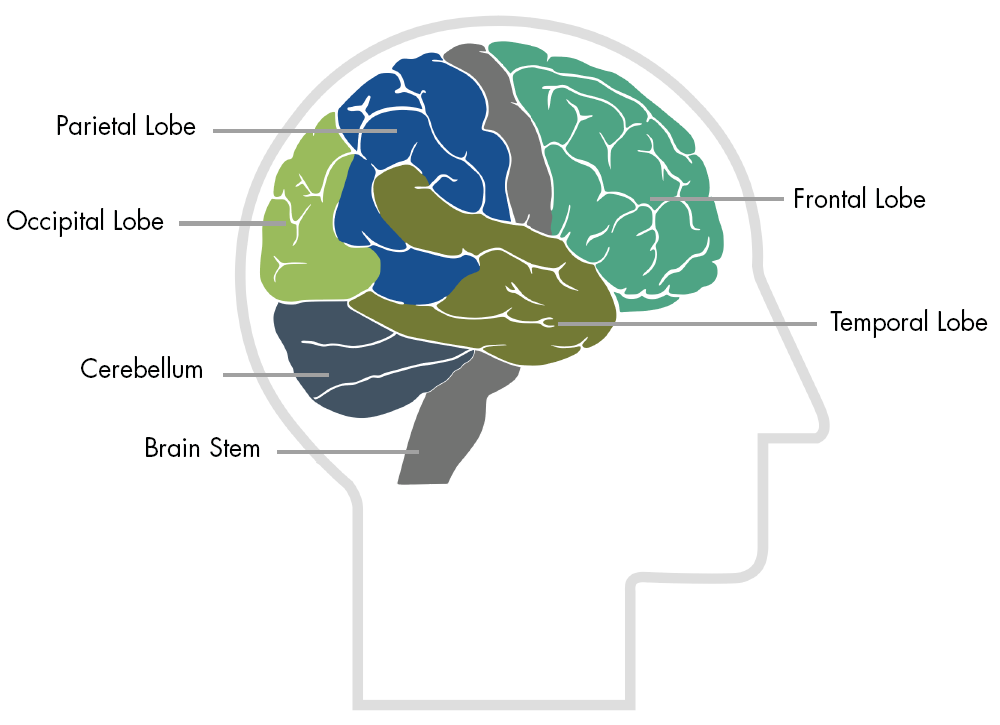
As I understand it, adolescent brains are different from adult brains. About a year ago I watched a documentary called "The Adolescent Brain." If I remember correctly, the major difference between adolescent and adult brains is that adolescents' frontal lobes are not fully developed.

The frontal lobe (pretty self-explanatory location) is responsible for decision making, considering consequences, planning ahead, and restraining risky behaviour.

What do you get when you have an undeveloped frontal lobe? You get speeding, stunts for the sake of a  Youtube video, impulsive spending, unprotected sex, etc., etc.

You get conversations like the one I overheard between two students today (while they were supposed to be using their work period in the library wisely!):

Student 1 (showing Student 2 a picture on her phone): "Yeah, I want to get this tattoo design, like really big, like, on my back."

Student 2: "That's super cool. It will be big, but still really cool. When are you gonna get it?"

Student 1: "Probably after prom, because I don't think it will look good with my dress."

... You're consciously putting off getting a large tattoo because you won't like it with certain outfits? What if you have a formal event in the future? What if you don't like the tattoo with your wedding dress? What if it doesn't look good in the bathing suit you buy next summer?

Maybe the frontal lobe can also be blamed for my very frustrating experience this morning. My first period class was supposed to launch into their partner presentations today. They had been given the rubric and project requirements a week ago. They had been given two full library work periods (75 minutes each), which should have been more than enough time for them to put together a short presentation on the colonial history of one African country.

Today I got a rude awakening into the real world of teaching. One by one, students dropped their problems, their stresses onto me:

"My friend spilled pop on my laptop this weekend."
"I emailed the powerpoint to myself, but it didn't open."
"I sent the presentation to my partner, but her mom accidentally deleted it."
"What do you mean by 'a handout'?"
"I didn't know what you meant by 'include the impact of colonialism' so I wasn't able to finish that part."
"I wasn't here on Friday." (with a look that says, "Obviously I wouldn't be ready!")
"I'm really tired this morning."
"I can't present -- I get anxiety."
"Can I go to the library to print something off?"
"My partner isn't here." (x3)

I felt so deflated and annoyed and stressed out by their problems. Grade. Twelve.

Of the entire class, only one person was completely ready to go (strangely enough, someone who chose to do it on their own!) What was I to do? My teacher and I lectured them and gave them 10 minutes to print, touch base, or find their powerpoint. After that amount of time, a few more groups were ready -- enough to fill the period.

I was further annoyed by one student who, claiming to "haaaate presentations," decided to have both her and her partner present by sitting in chairs behind the computer in the front corner of the classroom. Before they began (and before the whole class was listening), I suggested that she stand up to present.

She turned and gave me a look. "You're lucky I'm even up here!" she said.

I gave a little laugh. "No," I countered. "You're lucky that I'm letting you sit."

Your marks, not mine. Slouching behind a computer and reading off the screen in a mumbling voice will affect the "communication" aspect of your presentation :) When I mentioned this to my teacher later, I was told that this girl has not presented since grade six! At the beginning of the school year her mother approached my teacher to "let her know" that her daughter "doesn't do presentations."

Obviously that mother hasn't encountered a teacher like my supervising teacher -- with a stubborn determination to push her students.

"Well," my teacher had told her, "I don't exempt students from presentations just because they don't like doing them."

Teenagers may not have developed frontal lobes, but isn't that part of the reason they have parents? If your daughter is afraid of presentations (who isn't?) and frantic for any exit strategy (I've been there), she is not thinking ahead. She's not realizing that her fear is only going to get bigger and that she's never going to practice her presentation skills.

If a student has a real fear of public speaking, I'm all about flexibility (hence the option of powerpoint, presenting with a partner, etc.) But to have an attitude of entitlement, as if teachers owe her, as if "I'm lucky she's even up there" really gets under my skin! It's not a smart way to approach a teacher, especially if you're asking her for something or if you'll have to deal with her in the future.

Ignoring consequences and not taking  responsibility ... we can't blame everything on frontal lobes!


PS: Sorry that this turned into a bit of a rant -- long day! I promise, I really do like my students! 


Saturday, 5 January 2013

spelling matters

Some quotes from a recent assignment I marked for a grade 12 history class ... The question given to them was whether or not the benefits of technological advancements outweigh the harm. Now, before I publicly mock these students I do need to applaud them for at least writing their own assignments! I caught eight plagiarizers! These are for everyone who thinks spelling and grammar don't matter:

"The other testes included bone, muscle and nerve transplantation..."

"The benefits of these advancements out-way the cost" (you were given the word "outweigh" in the question!!)

This one isn't a spelling issue, but the student obviously gave up on an academic style: "Young girls are looking to the media for role models and all they are finding is celebrities with no meat on their bones to speak of running around half-naked on stage with more makeup than you can find in a drug store painted on their faces." Imagine that rant continuing for several pages.

And my personal favourite: "People ask who killed romance and shivery?"