I just finished reading Operating Instructions, Anne Lamott's memoir abut her son Sam's first year of life. I'm not a huge Lamott fan -- I only vaguely remembering reading Crooked Little Heart when I was a teenager, and an English teacher quoting Bird by Bird. At times I find the "honest, confessional" style of writing a bit much, and I didn't like the political comments in the book. I don't really understand reconciling your faith with demonizing one political party or the other (seemingly a staple of American politics at the moment), whichever "side" you're on. However... she is a good writer! Some of the descriptions and moments she captured in the memoir are bang-on, or created such a unique picture in my mind, that I had to write them down.
"I've had the secret fear of all mothers that my milk is not good enough...but Same seems to be thriving even though he's a pretty skinny little guy. I'm going to have an awards banquet for my body when all of this is over." (An awards banquet ... I love that!)
"His hands are like little stars."
"It's so great to have so many friends who had babies right around the time I did ... because they all have extremely bad attitudes and sick senses of humor like me. It would be intolerable to call a friend, a new mother, when you were feeling down and for her to say some weird aggressive shit like 'Little Phil slept through the night yesterday, isn't that marvelous since he's only eight weeks old, and guess what, I'm already fitting back into my pre-pregnancy clothes.' You'd really have no choice but to hope for disaster to rain down on such a person."
"If I could have on wish, just one crummy little wish, it would be that Sam outlive me."
"I went and stared at the crucifix for a long time and breathed it in. I believe in it, and it's so nuts. How did some famously cerebral and black-humored cynic like myself come to fall for all that Christian lunacy, to see the cross not as an end but a beginning, to believe as much as I believe in gravity or in the size of space that Jesus paid a debt he didn't owe because we had a debt we couldn't pay? It, my faith, is a great mystery. It has all the people close to me shaking their heads. It has me shaking my head."
"Part of my wants my body back, wants to stop being a moo-cow, and part of me thinks about nursing him through kindergarten. I know a woman who nursed her daughter until the girl was almost four, and of course we all went around thinking it was a bit much, too Last Emperor for our blood. But now when Sam and I are nursing, it crosses my mind that I will never ever be willing to give this up. It'll be okay, I think to myself, we can get it to work, I'll follow him to college but I'll stay totally out of the way...
This is the easiest, purest communication I've ever known."
"One thing about Sam, one things about having a baby, is that each step of the way you simply cannot imagine loving him any more than you already do, because you are bursting with love, loving as much as you are humanly capable of -- and then you do, you love him even more."
[upon news of her friend finding a lump in her breast] "Just like that. Boom. Can you imagine? Just like that. I feel a dread like hearing sirens late at night, like I did with my dad. I know it's bad. There's no doubt in my mind."
"Life is full of unexploded land mines, and she [the friend with cancer] seems to have stepped on one."
"I laughed so hard that it broke up the thin candy shell of fear that was covering my heart, and I could breathe again."
[on going up and down a wooden step for exercise] "Everyone's doing it. It's the most now and happening form of exercise, although my person belief is that thin smooth thighs do not necessarily speak of a rich inner life."
"When I held Sam alone for the first time, after Steve and Pammy had gone home the night that he was born, I was nursing him and feeling really spiritual, thinking, Please, please, God, help him be someone who feels compassion, who feels God's presence loose in the world, who doesn't give up on peace and justice and mercy for everyone. And then one second later I was begging, Okay, skip all that shit, forget it -- just please, please let him outlive me."
Showing posts with label what I'm reading. Show all posts
Showing posts with label what I'm reading. Show all posts
Tuesday, 22 May 2018

Monday, 2 October 2017
love warrior - quotes from the book
Quotes from the book Love Warrior by Glennon Doyle. Don't agree with Glennon on everything, but she is a beautiful writer and gives a lot of truth to chew on. A very thought-provoking book!
Chapter 1
[in high school, in the cafeteria at lunch]
"Before I take a step forward I wish vehemently that we had assigned seats. I look out at the sea of faces and understand that we are all drowning in freedom. Where are the adults? We need them here."
[in the hospital being treated for bulimia]
"One day a girl with sliced-up arms says, 'My mom sent me here because she says no one can believe a word I say.' I look at her and I want to say: Does she see that you tell the truth on your arms? Like I tell the truth in the toilet? By the time we landed in the hospital, most of our families considered us insensitive liars, but we didn't start out that way. We started out as ultrasensitive truth tellers. We saw everyone around us smiling and repeating 'I'm fine! I'm fine! I'm fine!' and we found ourselves unable to join them in all the pretending. We had to tell the truth, which was: 'Actually, I'm not fine.' But no one knew how to handle hearing that truth, so we found other ways to tell it. We used whatever else we could -- drugs, booze, food, money, our arms, other bodies. We acted out our truth instead of speaking it and everything became a godforsaken mess. But we were just trying to be honest."
"The hidden, truest rules about how to matter as a girl are: Be Thin. Be Pretty. Be Quiet."
Chapter 4
[on the bathroom floor, facing an unexpected positive pregnancy test]
"...I get stuck on that phrase as it runs through my mind. Free for all. Maybe grace is free. Free for the taking. Maybe it's even free for me. This free-for-all overwhelms me, fill me, covers me, convinces me. I decide to believe. Something in me says yes to the idea that there is a God and that this God is trying to speak to me, trying to love me, trying to invite me back to life. I decide to believe in a God who believes in a girl like me.
"The God I decide to believe in is the God of the bathroom floor. A God of scandalously low expectations. A God who smiles down at a drunk on the floor, wasted and afraid, and says, There you are. I've been waiting. Are you ready to make something beautiful with me?"
[realizing the difficulty of getting sober]
"This is the difference between God and booze. God requires something of us. The booze numbs the pain but God insists on nothing short of healing. God deals only with truth and the truth will set you free, but it will hurt so badly at first."
Chapter 6
[holding her baby for the first time]
"I am this baby's mother. He is mine. I am his. He is the key I've been waiting for my entire life. I am unlocked. Chase and I belong to each other."
Chapter 7
[reading people's responses to her honest Facebook post]
"I marvel at the honesty and pain. Many messages are from people I've known for years, but I'm discovering that I never really knew them. We've spent our time together talking about everything but what matters. We've never brought to each other the heavy things we were meant to help each other carry. We've only introduced each other to our representatives, while our real selves tried to live life alone. We thought that was safer. We thought that this way our real selves wouldn't get hurt. But as I read these messages, it becomes clear that we are all hurting anyway. And we think we are alone. At our cores, we are our tender selves peeking out at a world of shiny representatives, so shame has been layered on top of our pain. We're suffocating underneath all the layers."
Chapter 9
Types of listeners to the news of her marriage -- the Shover, the Comparer, the Reporter, the God Reps, the Victims, etc.
Chapter 10
"The surf continues to hit the sand rhythmically and dependably and I trust it will continue. The sun is setting but I know it will rise again tomorrow. There is a pattern to things. This makes me wonder if I can also trust that there is a pattern, a rhythm, a beauty, a natural rise and fall to my life as well. I wonder if the one holding together this sky might also be capable of holding together my heart. I wonder if the one making this sky so achingly beautiful might also be working to make my life beautiful, too."
"I don't know how to fix my marriage. All I know is that I need to tear down my own walls and face what's underneath . . . I look out at the sea, up at the sky, and down at the sand. I think, I can be brave enough to tear myself down -- because the One holding all of this together will hold me, too."
Chapter 13
"It strikes me that it's always the most religious people who are most surprised by grace . . . We sweep up our mess and hide our doubts, contradictions, anger and fear before showing ourselves to God, which like putting on a fancy dress and makeup to prepare for an X-ray."
"We are all desperate for reunion and we are trying to find it in all the wrong places. We use bodies and drugs and food to end our loneliness, because we don't understand that we're lonely down here because we are supposed to be lonely. Because we're in pieces. To be human is to be incomplete and constantly yearning for reunion."
"Fear doesn't make perfect love untrue any more than passing clouds make the stars untrue. I know how to find my way back to truth, to love, to peace, to God again. All I have to do is be still and breathe and wait for the clouds and fear to pass."
Chapter 15
"But what the hell does sexy even mean? I wonder if the word sexy is everything that made sex a lie to me . . . Sexy was one type of body and one color of hair and spending an entire life looking into the mirror instead of out at the world . . . I'd been trying to be that kind of sexy for twenty years, and I realize that's going to have to change. That definition of sexy is what poisoned my husband and me and it's never going to work for us again . . . Maybe I can find my own sexy."
"Women who are concerned with being pretty think about what they look like, but women who are concerned with being beautiful think about what they are looking at. They are taking it all in. They are taking in the whole beautiful world and making all that beauty theirs to give away to others."
"I consider the possibility that I've been right and wrong my whole life. I was right to want to be beautiful and sexy; I was just wrong to have accepted someone else's idea of what those words mean. It strikes me that I need to throw out the dictionary the world gave me about what it means to be a mother, a wife, a person of faith, an artist, and a woman and write my own."
Unsure which chapter ...
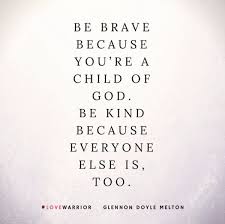
"Be brave because you are a child of God. Be kind because everyone else is, too."
Chapter 1
[in high school, in the cafeteria at lunch]
"Before I take a step forward I wish vehemently that we had assigned seats. I look out at the sea of faces and understand that we are all drowning in freedom. Where are the adults? We need them here."
[in the hospital being treated for bulimia]
"One day a girl with sliced-up arms says, 'My mom sent me here because she says no one can believe a word I say.' I look at her and I want to say: Does she see that you tell the truth on your arms? Like I tell the truth in the toilet? By the time we landed in the hospital, most of our families considered us insensitive liars, but we didn't start out that way. We started out as ultrasensitive truth tellers. We saw everyone around us smiling and repeating 'I'm fine! I'm fine! I'm fine!' and we found ourselves unable to join them in all the pretending. We had to tell the truth, which was: 'Actually, I'm not fine.' But no one knew how to handle hearing that truth, so we found other ways to tell it. We used whatever else we could -- drugs, booze, food, money, our arms, other bodies. We acted out our truth instead of speaking it and everything became a godforsaken mess. But we were just trying to be honest."
"The hidden, truest rules about how to matter as a girl are: Be Thin. Be Pretty. Be Quiet."
Chapter 4
[on the bathroom floor, facing an unexpected positive pregnancy test]
"...I get stuck on that phrase as it runs through my mind. Free for all. Maybe grace is free. Free for the taking. Maybe it's even free for me. This free-for-all overwhelms me, fill me, covers me, convinces me. I decide to believe. Something in me says yes to the idea that there is a God and that this God is trying to speak to me, trying to love me, trying to invite me back to life. I decide to believe in a God who believes in a girl like me.
"The God I decide to believe in is the God of the bathroom floor. A God of scandalously low expectations. A God who smiles down at a drunk on the floor, wasted and afraid, and says, There you are. I've been waiting. Are you ready to make something beautiful with me?"
[realizing the difficulty of getting sober]
"This is the difference between God and booze. God requires something of us. The booze numbs the pain but God insists on nothing short of healing. God deals only with truth and the truth will set you free, but it will hurt so badly at first."
Chapter 6
[holding her baby for the first time]
"I am this baby's mother. He is mine. I am his. He is the key I've been waiting for my entire life. I am unlocked. Chase and I belong to each other."
Chapter 7
[reading people's responses to her honest Facebook post]
"I marvel at the honesty and pain. Many messages are from people I've known for years, but I'm discovering that I never really knew them. We've spent our time together talking about everything but what matters. We've never brought to each other the heavy things we were meant to help each other carry. We've only introduced each other to our representatives, while our real selves tried to live life alone. We thought that was safer. We thought that this way our real selves wouldn't get hurt. But as I read these messages, it becomes clear that we are all hurting anyway. And we think we are alone. At our cores, we are our tender selves peeking out at a world of shiny representatives, so shame has been layered on top of our pain. We're suffocating underneath all the layers."
Chapter 9
Types of listeners to the news of her marriage -- the Shover, the Comparer, the Reporter, the God Reps, the Victims, etc.
Chapter 10
"The surf continues to hit the sand rhythmically and dependably and I trust it will continue. The sun is setting but I know it will rise again tomorrow. There is a pattern to things. This makes me wonder if I can also trust that there is a pattern, a rhythm, a beauty, a natural rise and fall to my life as well. I wonder if the one holding together this sky might also be capable of holding together my heart. I wonder if the one making this sky so achingly beautiful might also be working to make my life beautiful, too."
"I don't know how to fix my marriage. All I know is that I need to tear down my own walls and face what's underneath . . . I look out at the sea, up at the sky, and down at the sand. I think, I can be brave enough to tear myself down -- because the One holding all of this together will hold me, too."
Chapter 13
"It strikes me that it's always the most religious people who are most surprised by grace . . . We sweep up our mess and hide our doubts, contradictions, anger and fear before showing ourselves to God, which like putting on a fancy dress and makeup to prepare for an X-ray."
"We are all desperate for reunion and we are trying to find it in all the wrong places. We use bodies and drugs and food to end our loneliness, because we don't understand that we're lonely down here because we are supposed to be lonely. Because we're in pieces. To be human is to be incomplete and constantly yearning for reunion."
"Fear doesn't make perfect love untrue any more than passing clouds make the stars untrue. I know how to find my way back to truth, to love, to peace, to God again. All I have to do is be still and breathe and wait for the clouds and fear to pass."
Chapter 15
"But what the hell does sexy even mean? I wonder if the word sexy is everything that made sex a lie to me . . . Sexy was one type of body and one color of hair and spending an entire life looking into the mirror instead of out at the world . . . I'd been trying to be that kind of sexy for twenty years, and I realize that's going to have to change. That definition of sexy is what poisoned my husband and me and it's never going to work for us again . . . Maybe I can find my own sexy."
"Women who are concerned with being pretty think about what they look like, but women who are concerned with being beautiful think about what they are looking at. They are taking it all in. They are taking in the whole beautiful world and making all that beauty theirs to give away to others."
"I consider the possibility that I've been right and wrong my whole life. I was right to want to be beautiful and sexy; I was just wrong to have accepted someone else's idea of what those words mean. It strikes me that I need to throw out the dictionary the world gave me about what it means to be a mother, a wife, a person of faith, an artist, and a woman and write my own."
Unsure which chapter ...
"Be brave because you are a child of God. Be kind because everyone else is, too."
Monday, 23 January 2017
People Like Us - Quotes
I just finished reading People Like Us by Joris Luyendijk, a former Dutch news correspondent to the Middle East. While the style of the book is easy to read, the concepts are thought-provoking. Luyendijk reveals the inner workings of the international news machine, and reflects on how the Middle East in particular is often misrepresented and misunderstood in Western media. Note to self: read his other book, Hello Everybody!
Some quotes ...
"I had always thought that the 'news' was a compilation of the most important things in the world. But after six months as a correspondent, reality set in. News is only what is different from the everyday -- the exception to the rule. With an unknown world like the Arab one, this has a distorting effect. When someone is shot on Dam Square in Amsterdam, it's news, but Dutch people know that people aren't normally shot there. They've been there themselves, or they know someone who went there and returned safely. But how much do Dutch people know about daily life in the Middle East? . . . If you are told only about the exceptions, you'll think they are the rule." (37)
"Dictatorship itself is the most important thing to report about in the Arab world . . . Writing 'around' this was like reporting on France or the Netherlands in 1943 without mentioning the occupation."
"Did the hundreds of thousands of anti-war demonstrators in Europe know what Saddam did to his subjects? I was not aware that many of the demonstrators thought anything other than: 'Of course dictators are bad, but war is really horrible, so we're against it under any circumstances --- Peace, man!' I'd say dictatorship is war, too; a regime's war on its own people." (214)
"The borders of the Middle East had been drawn by foreign, largely European, powers at the end of the First World War in order to facilitate their domination of the area." (quoting Henry Kissinger in Diplomacy)
Some quotes ...
"I had always thought that the 'news' was a compilation of the most important things in the world. But after six months as a correspondent, reality set in. News is only what is different from the everyday -- the exception to the rule. With an unknown world like the Arab one, this has a distorting effect. When someone is shot on Dam Square in Amsterdam, it's news, but Dutch people know that people aren't normally shot there. They've been there themselves, or they know someone who went there and returned safely. But how much do Dutch people know about daily life in the Middle East? . . . If you are told only about the exceptions, you'll think they are the rule." (37)
"Dictatorship itself is the most important thing to report about in the Arab world . . . Writing 'around' this was like reporting on France or the Netherlands in 1943 without mentioning the occupation."
"Did the hundreds of thousands of anti-war demonstrators in Europe know what Saddam did to his subjects? I was not aware that many of the demonstrators thought anything other than: 'Of course dictators are bad, but war is really horrible, so we're against it under any circumstances --- Peace, man!' I'd say dictatorship is war, too; a regime's war on its own people." (214)
"The borders of the Middle East had been drawn by foreign, largely European, powers at the end of the First World War in order to facilitate their domination of the area." (quoting Henry Kissinger in Diplomacy)
Thursday, 29 May 2014
biblical blindspots

He
spoke about culture as an iceberg, with the noticeable things we usually talk
about -- clothing, language, food -- as the tip of the iceberg. The bulk of the
iceberg is what is below the surface, and it is what "goes without being
said." As we read the Bible, we miss what "goes without being
said" and we insert our own culture's norms. As Westerners, we have blind
spots when we approach Scripture.
At the
conference Randy made it clear that he is not merely criticizing the West; every
culture has blind spots, but he wrote a book targeted to white Western males
because he is a white Western male. He hopes that every culture tries to
critically examine the blind spots they may have when it comes to Scripture.
I
bought a copy of the book Richards co-wrote, called Misreading Scripture with Western Eyes. I highly recommend it. It
has helped me look at the Bible in a different way and, living in Uganda,
helped me understand some of the deeper differences in culture. When I have moments of "Huh?" even
though we're both speaking English, it's usually because I'm unaware of the
currents of thought running below the surface.
The
book begins by addressing more obvious issues such as language and race. The
next section skims just below the surface, touching on the differences between
collectivism and individualism, the concept of time, and honour/shame vs.
right/wrong. (Retelling the story of David and Bathsheba through the lens of an
honour/shame culture was very insightful.) The next section goes even deeper,
into rules vs. relationships, what we consider to be virtues and vices, and
finally how we in the West often perceive ourselves as at the centre of God's
will. As the book goes deeper and deeper into "what goes without being
said," I realized how near and dear some Western cultural values are to my
heart, even if they are Biblically neutral or even contrary to Scripture.
Some
quotes:
"We
can easily forget that Scripture is a foreign land and that reading the Bible
is a cross-cultural experience."
"The
most powerful cultural values are those that go without being said."
"Church
history is a two-thousand-year-long conversation about how the eternal truth of
Scripture applies in different cultures at different times."
[On the
Western tendency to ignore Paul's verses praising singleness]: "... what
goes without being said amongst Western Christians, especially in America, is
that celibacy has no inherent spiritual value . . . Because we privilege
marriage as God's preferred way of life for everyone, churches in America, on
the whole, do a very poor job of ministering to single adults."
"The
highest goal and virtue in [Western individualist] culture is being true to
oneself. The supreme value is on the sovereignty of the individual . . . The
highest goal in [collectivist] culture is supporting the community."
[Interesting
note on collectivist culture: Indonesian Christians were shocked to learn that
American parents allow their Christian teenagers to go on dates at night
unsupervised. "For Indonesians, it seems unfair to leave an individual in
a situation in which his or her only real protection is willpower . . .
Indonesian Christian teens are relieved that someone else is responsible for
protecting them.]
[On
Western tendency to see ourselves at the centre of God's will -- that chapter
was hard to read!]: "When we realize that each passage of Scripture is not
about me, we begin gradually to see that the true subject matter of the Bible,
what the book is really about, is God's redeeming work in Christ. God is
restoring all of creation (including me), but I am not at the centre of God's
kingdom work. This is a much greater thing to be absorbed with than ourselves
." [Paraphrasing now]: Instead of reading the Bible and asking, "What
does this mean to me?" find out
what it meant to the original audience and ask, "How does this apply to me?"
General
tips for reading the Bible: "We are
likely misreading when our reading of the text requires us to ignore the
context, to shorten the text to just this or that verse or part of a verse. We
are likely misreading when our reading of the text requires us to lengthen the
text, by pulling in verses from other parts of the Bible until we get all the
pieces we need . . . Other times, though, we misread because we read alone.
That is, we often hear only the interpretations of people just like us . . . The worldwide church needs to learn to study
Scripture together as a global community."
Friday, 2 May 2014
the greatest saints?
"Some of the people we met had nothing, absolutely nothing, but they were so happy," Kimberly said. She extracted a photograph from the crowded back of the piano, of her daughter with two Indian women, their skin dark and weathered, their smiles showing missing teeth. "These women were so wonderful," she said.
Ifemelu would also come to learn that, for Kimberly, the poor were blameless. Poverty was a gleaming thing; she could not conceive of poor people being vicious or nasty, because their poverty had canonized them, and the greatest saints were the foreign poor.
-- Americanah by Nigerian author Chimamanda Adichie
I just finished Americanah, probably the longest book I've read for quite some time. I had shown my grade 8 class the Ted Talk by Chimamanda Adichie called "The Danger of the Single Story." (Take 20 minutes and watch it! The best quote: "The trouble with stereotypes is not that they are untrue, but that they are incomplete.") One of my students told her mother about it, who is a big Adichie fan, and since then they've been feeding me Adichie novels one at a time.
I have to say that I enjoyed Purple Hibiscus more than Americanah. Americanah is the story of a Nigerian woman who moves to America and then back to Nigeria, with a love story woven the whole way through. Americanah was too long for my taste (477 pages!) and I felt that it started to get repetitive after awhile. I also didn't like the fact that the guy in the book leaves his wife to get back together with his one true love when she returns to Nigeria. There were some funny parts in the book when the character Ifemelu first moves to America and experiences culture shock, which I found interesting since it's the flip side of what I've experienced here in Uganda.
One thing Adichie is really good at -- in both of the novels I've read -- is complicating things. In the scene quoted above, when Ifemelu is working in America as a nanny for the wealthy, soft-hearted Kimberly, Adichie complicates the view that many people in the West have of "the greatest saints ... the foreign poor."
The greatest saints.
I have to admit I've been guilty of that. My sister works at an addictions centre in Canada, and I recently said to her, "That kind of urban poverty scares me. It's so complicated. Here in Uganda, it seems more black-and-white: this hardworking woman needs $100 for a sewing machine to start her own small business."
But the longer I'm here, the less I know. Everything gets so complicated, so gray. Sometimes it seems that every way to "help" is analyzed, criticized, and somewhere, someone has a reason why such practices are actually doing harm.
And whether I'm negative or positive about Ugandan culture, up or down, "the Ugandan poor" refuse to fit into the mental boxes I build for them.
There's the woman who tends her shop all day, every day, and makes around $3 profit on a good day. There's the kids who will smile and grab your hand. There's also the kids who swarmed a friend of mine, holding her hands and smiling at her while one kid dipped his hand into her purse. There's the woman who does your laundry, who you know lives in basically a shack the size of a walk-in closet, and she returns the 5000 shillings ($2) she found in your pocket. There's the people who must have watched my neighbour's house, robbing them in broad daylight when the house was left unattended for less than an hour. There's a shopkeeper who takes a microloan and invests it. There's a shopkeeper who takes a microloan and wastes it.There's the Congolese ladies learning English at a nearby shelter who don't know where their families are or whether or not they're alive, and yet they are bright and cheerful and somehow find optimism.
There's the hordes of young men who are jobless and who insist that, if given the chance, they would work hard. There's the night guards who sleep on the job. There's the Ugandan church lady who slips a wrinkled 1000 shilling note (40 cents) into the hand of hospital patient she is praying with. There's the alcoholic sucking waragi out a plastic bag, reeking of alcohol and leering at you. There's the stranger who will take you to the store you're looking for downtown, even if it's far out of his way. There's the person who will unzip the top pocket on your backpack to rob you as you are walking downtown (which happened to Isaac this past week). But then there's also the guy who hissed protectively to Isaac, "Mzungu! You need to take care! You were almost robbed."
Everything's complicated, and why am I surprised? Isn't painting an entire group of people in a positive light still painting them with the same brush? Isn't endowing someone with virtues simply because of their class or skin colour the same as pegging them with negative assumptions (ex: the stereotype of the "noble savage" in Canada).
People are not projects. People are not objects of pity. People are not perfect. People are not predictable. People are people, and people are complicated. (Even poor people in Africa!)

Ifemelu would also come to learn that, for Kimberly, the poor were blameless. Poverty was a gleaming thing; she could not conceive of poor people being vicious or nasty, because their poverty had canonized them, and the greatest saints were the foreign poor.
-- Americanah by Nigerian author Chimamanda Adichie
I just finished Americanah, probably the longest book I've read for quite some time. I had shown my grade 8 class the Ted Talk by Chimamanda Adichie called "The Danger of the Single Story." (Take 20 minutes and watch it! The best quote: "The trouble with stereotypes is not that they are untrue, but that they are incomplete.") One of my students told her mother about it, who is a big Adichie fan, and since then they've been feeding me Adichie novels one at a time.
I have to say that I enjoyed Purple Hibiscus more than Americanah. Americanah is the story of a Nigerian woman who moves to America and then back to Nigeria, with a love story woven the whole way through. Americanah was too long for my taste (477 pages!) and I felt that it started to get repetitive after awhile. I also didn't like the fact that the guy in the book leaves his wife to get back together with his one true love when she returns to Nigeria. There were some funny parts in the book when the character Ifemelu first moves to America and experiences culture shock, which I found interesting since it's the flip side of what I've experienced here in Uganda.
One thing Adichie is really good at -- in both of the novels I've read -- is complicating things. In the scene quoted above, when Ifemelu is working in America as a nanny for the wealthy, soft-hearted Kimberly, Adichie complicates the view that many people in the West have of "the greatest saints ... the foreign poor."
The greatest saints.
I have to admit I've been guilty of that. My sister works at an addictions centre in Canada, and I recently said to her, "That kind of urban poverty scares me. It's so complicated. Here in Uganda, it seems more black-and-white: this hardworking woman needs $100 for a sewing machine to start her own small business."
But the longer I'm here, the less I know. Everything gets so complicated, so gray. Sometimes it seems that every way to "help" is analyzed, criticized, and somewhere, someone has a reason why such practices are actually doing harm.
And whether I'm negative or positive about Ugandan culture, up or down, "the Ugandan poor" refuse to fit into the mental boxes I build for them.
There's the woman who tends her shop all day, every day, and makes around $3 profit on a good day. There's the kids who will smile and grab your hand. There's also the kids who swarmed a friend of mine, holding her hands and smiling at her while one kid dipped his hand into her purse. There's the woman who does your laundry, who you know lives in basically a shack the size of a walk-in closet, and she returns the 5000 shillings ($2) she found in your pocket. There's the people who must have watched my neighbour's house, robbing them in broad daylight when the house was left unattended for less than an hour. There's a shopkeeper who takes a microloan and invests it. There's a shopkeeper who takes a microloan and wastes it.There's the Congolese ladies learning English at a nearby shelter who don't know where their families are or whether or not they're alive, and yet they are bright and cheerful and somehow find optimism.
There's the hordes of young men who are jobless and who insist that, if given the chance, they would work hard. There's the night guards who sleep on the job. There's the Ugandan church lady who slips a wrinkled 1000 shilling note (40 cents) into the hand of hospital patient she is praying with. There's the alcoholic sucking waragi out a plastic bag, reeking of alcohol and leering at you. There's the stranger who will take you to the store you're looking for downtown, even if it's far out of his way. There's the person who will unzip the top pocket on your backpack to rob you as you are walking downtown (which happened to Isaac this past week). But then there's also the guy who hissed protectively to Isaac, "Mzungu! You need to take care! You were almost robbed."
Everything's complicated, and why am I surprised? Isn't painting an entire group of people in a positive light still painting them with the same brush? Isn't endowing someone with virtues simply because of their class or skin colour the same as pegging them with negative assumptions (ex: the stereotype of the "noble savage" in Canada).
People are not projects. People are not objects of pity. People are not perfect. People are not predictable. People are people, and people are complicated. (Even poor people in Africa!)
Thursday, 17 October 2013
begging: to give or not to give?
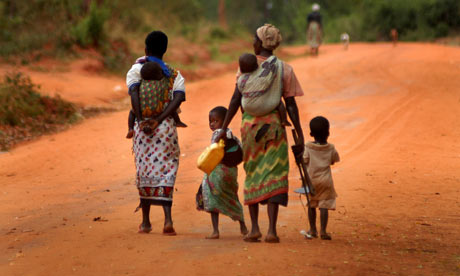
One of the toughest things to deal with here is encounters with beggars -- children and adults alike. Women hold babies that are not their own, children ask for food or money, men with severe physical disabilities sit by the side of their road.
Sometimes kids in the neighbourhood or villages playfully demand, "Muzungu -- give me money!" (or water, or your watch) and it's easy to laugh and say, "I don't think so!" But many others are serious, and it is not a joke.
What should one do? Everything in you feels the need to give something, whether it be food or money. This article sheds light on how giving in to that impulse to hand over something, anything -- can actually be harmful. Generous tourists can unknowingly fuel a vicious criminal system of child trafficking. If you are ever going to travel to the third world (or even parts of the first world!) you should read this!
http://www.slate.com/articles/double_x/doublex/2013/09/giving_money_to_child_beggars_don_t_do_it.html
Sometimes kids in the neighbourhood or villages playfully demand, "Muzungu -- give me money!" (or water, or your watch) and it's easy to laugh and say, "I don't think so!" But many others are serious, and it is not a joke.
What should one do? Everything in you feels the need to give something, whether it be food or money. This article sheds light on how giving in to that impulse to hand over something, anything -- can actually be harmful. Generous tourists can unknowingly fuel a vicious criminal system of child trafficking. If you are ever going to travel to the third world (or even parts of the first world!) you should read this!
http://www.slate.com/articles/double_x/doublex/2013/09/giving_money_to_child_beggars_don_t_do_it.html
Friday, 3 May 2013
review: girls like us
In Girls Like Us, Lloyd
frames general information about the sex industry around her own personal
experience. Chapters focus on different aspects of the industry: recruitment,
reasons girls stay, pimps, johns, cops, what enables women to leave, etc. Each
chapter begins with her Lloyd’s own experience, and then launches into the
experiences of other girls at GEMS, supported by psychological and sociological
research.
This book is a powerful one. Lloyd’s passion burns off the
pages. I became emotionally connected to the different girls’ stories that
Lloyd shared, as well as her own healing process that she shared so honestly.
At the same time, I learned a lot of information about the reality of the sex
industry.
One of Lloyd’s major points is that we need to stop viewing
exploited girls as criminals, and start viewing them as victims. While for many
people the word “prostitute” conjures up surly, drug-addicted, “loose” women
the reality is that the average age of entry for prostitution in the United States is thirteen! When
you hear “teenage prostitute,” think of a twelve year old. An eleven year old.
Lloyd raises the important point: when a prostitute is from
a foreign country, why is it so much easier for us to see her as a victim, even
if she made the “choice” to move here?
Although Lloyd doesn’t focus on spiritual conversion, and it
is not the central mission of GEMS (although prayer and faith play a major
role), I was so encouraged to read how it was so clearly the love of God that
plucked her out of the sex industry. I was humbled, reminded how Jesus loved
the shunned, the prostitutes, the sinners, the broken, the oppressed. Guess
what? He still does, and we’re called to do the same.
Some quotes from Girls
Like Us:
“In one way or another, through abuse, neglect, abandonment,
we’d [exploited girls] been primed for predatory men, for an industry that
would use us up and spit us out.” (27)
“I find that there is a common belief from people asking
about my work, that sexually exploited girls must be drug addicted, and that it is the addiction that fuels the
exploitation. Yet. . . I’ve found very few girls who are addicted to ‘hard’
drugs and for whom the addiction came prior to the exploitation. . . Girls
weren’t drug addicted, they were love addicted, and that, I’d learn, is far
harder to treat.” (38)
“Of course many children who grow up in challenging economic
situations thrive, but the reality is that far too many don’t, and too many
children’s futures can be determined by zip code.” (40)
“Children are vulnerable just by virtue of being children. .
. Pimps understand child psychology and adolescent development well enough to
know the dynamics at play and skillfully manipulate most children…into a
situation where they can be forced or coerced into being sold for sex.” (46)
“Prostitution is viewed as a victimless crime, a statement
that denies the humanity or victimhood of the women and girls involved.” (126)
[When Lloyd decided to leave her pimp:] “But the thought
that maybe I have a greater purpose leads me to a small nondenominational
American church the following Sunday, and that sets me on a path that will
result in my walking away from the life two months later and never going back. This inexplicable belief in God’s love for
me at a critical moment sustains me over the next few months, and ultimately
over the next decade.” (171)
“ ‘Rescuing’ trafficking victims may sound like a fantastic
idea, but talk to any service provider who works with these children and youth,
whether in India, Cambodia, Ukraine, Atlanta, or Brooklyn, and you’ll hear that
the reality is a little more complex. Victims rarely rush gratefully into your
open arms; they’re not immediately compliant with shelter regulations; they
don’t trust the people trying to help them. They’re tired and traumatized and
hurting and lonely and depressed and scared and to them, missing the life is as
normal as breathing. Healing is a messy, complicated process that’s rarely
linear.” (163)
“Domestic violence is often framed as a result of
uncontrollable passion, leading girls to believe that men who don’t hit are
apathetic and uncaring. It’s not surprising that so many teenage girls accept
violence as part of their relationships – violence as an expression of love.”
(199)
“The sex industry isn’t about choice, it’s about lack of
choices.” (219)
Tuesday, 23 April 2013
the great gatsby
-cover.jpg) The Great Gatsby has been on my to-read list for quite some time. One of the strange things about going to church in a movie theatre is walking by movie posters on your way in and out. Every Sunday for the last few weeks, I've been walking by a giant four-sided cardboard advertisement for the movie The Great Gatsby. I knew I had to read the novel before seeing the film version, so when Cole's had a convenient display dedicated to the book I picked up a copy.
The Great Gatsby has been on my to-read list for quite some time. One of the strange things about going to church in a movie theatre is walking by movie posters on your way in and out. Every Sunday for the last few weeks, I've been walking by a giant four-sided cardboard advertisement for the movie The Great Gatsby. I knew I had to read the novel before seeing the film version, so when Cole's had a convenient display dedicated to the book I picked up a copy. A willing victim of marketing.
I really enjoyed The Great Gatsby. Even though it was published in 1925, Fitzgerald's writing is fresh and powerful. It was interesting to read from a historical perspective -- the main character talks about "going into bonds" because "everyone he knows is going into bonds," just a few years shy of the stock market crash. I had also learned in history classes how World War I had rocked Western culture. The shining promises of progress were replaced with doubts, disillusion and distrust. This shift can be felt in The Great Gatsby.
I did not expect this book, set in "the roaring twenties," to be sad. But it was one of the saddest books I have ever read. Underneath the clothes, the cars, the glitz, the lights . . . there is a persistent emptiness in the world Fitzgerald creates. Characters are surrounded by people, yet lonely. Lives end abruptly, meaninglessly, and funerals are sparsely attended. Marriages are empty and love is fleeting. Things are broken. Identities are false, the past has been carefully crafted. All of the wealth that is showcased in the novel is ... hollow.
The book is haunting, yet I believe it is so relevant today. My philosophy professor at Redeemer liked to call modern culture a culture of "cheerful nihilism." Everything is meaningless, it's all about having fun and chasing temporary pleasures along the way. It's about the Facebook photos, the appearances, the practiced smiles. But there are so many people -- especially young people -- who feel rootless, who are grasping after significance. The Great Gatsby reminds me again of the raw need for God, the hunger for hope and meaning.
Some of my favourite quotes from The Great Gatsby:
"'Whenever you feel like criticizing anyone,' he told me, 'just remember that all the people in this world haven't had the advantages that you've had.'" (1)
[Daisy, about her newborn daughter] "I'm glad it's a girl. And I hope she'll be a fool --- that's the best thing a girl can be in this world, a beautiful little fool." (22)
"...the silver pepper of the stars." (25)
"... the cab stopped at one slice in a long white cake of apartment-houses." (31)
[Nick, the narrator]: "Everyone suspects himself of at least one of the cardinal virtues, and this is mine: I am one of the few honest people that I have ever known." (59)
"... the clock ticked on the washstand and the moon soaked with wet light his tangled clothes upon the floor." (95)
[Nick sitting beside Jordan in the car, contemplating his 30th birthday and the passing of time]: "So we drove on toward death through the cooling twilight." (129)
"... a hundred houses, at once conventional and grotesque, crouching under a sullen, overhanging sky and a lustreless moon." (167)
"Her hand ... sparkles cold with jewels." (167)
"They were careless people, Tom and Daisy -- they smashed up things and creatures and then retreated back into their money or their vast carelessness, or whatever it was the kept them together, and let other people clean up the mess they had made..." (170)
And the last words of the novel ...
"Gatsby believed in the green light, the orgastic future that year by year recedes before us. It eluded us then, but that's no matter -- tomorrow we will run faster, stretch out our arms further .... And on fine morning ---
So we beat on, boats against the current, borne back ceaselessly into the past." (172)
Friday, 29 March 2013
cornerstone vs. capstone
I was glad when a friend sent me a link to this online article: The Case for Getting Married Young. It discusses the trend of young adults viewing marriage as a "capstone" to their adult lives, and raises the question of whether marriage should be viewed as a "cornerstone" instead.
While no one should ever rush into marriage, and while at any age the most important thing is who you marry, it is nice to read something that supports my choice to get married at twenty.
Two and half years after the wedding, people still look at me like I have two heads when I tell them I'm married. Heads whip around. The questions start firing, and suddenly I need to justify why I'm married. Isaac and I used to be a little embarrassed. We both confessed to avoiding the words "my husband" or "my wife" to dodge the predictable reaction. Now, I've become less self-conscious. When they look at me with shock (and is it sometimes disgust?) I just smile and say, "Yup, I'm married. And I'm not even a newlywed. This summer it will be three years."
Instead of second-guessing our decision, I've become even more convinced we did the right thing. We love being married. I have had more adventures than I would have had if I were single. Would I have been able to move to Halifax by myself for a year? Would I have driven to the Grand Canyon? Would I be planning to go to Uganda this August? Would I have picked up and worked in Alberta for a summer?
In my experiences of brief travel (a few months) as a single girl, I realized that I was cut out to have a partner. Going places without being to share it with someone else felt a little hollow. I think God knew what I needed, and brought Isaac and I together at a young age.
When we were engaged we even got flack from people in the church. People asked us how we would support ourselves. People encouraged us to not "miss out" on the fun we could only have being single.
For the record, I think marriage has benefited both of us financially. When one of us is busier with work, the other picks up the slack for cooking and cleaning at the apartment. We share a car. We gain from each others' areas of strength. And being independent at a young age has stretched our characters by leaps and bounds. We enjoy being frugal -- garage sales and wild berry picking have become sources of quality time together.
As for having fun, Isaac is my best friend. I get to live with him and share everything with him. If I got married at an older age, set in my ways, maybe I wouldn't have been able to grow as much as I have. I have gone on an overnight canoe trip -- even a winter camping trip! (never again) -- something I would have never done without him. I have loved every adventure we have shared together and know that there are plenty more down the road!
As a family friend told me when we were engaged, getting married young means you build history.
"My husband understands me and the way I react to things, because he knows my past experiences. He was there when they happened!"
I'm not trying to knock anyone who is single, because God can use you in amazing ways when you are. All I'm saying is please don't criticize those who marry young, who chose to build their adult lives on the cornerstone of marriage.
While no one should ever rush into marriage, and while at any age the most important thing is who you marry, it is nice to read something that supports my choice to get married at twenty.
Two and half years after the wedding, people still look at me like I have two heads when I tell them I'm married. Heads whip around. The questions start firing, and suddenly I need to justify why I'm married. Isaac and I used to be a little embarrassed. We both confessed to avoiding the words "my husband" or "my wife" to dodge the predictable reaction. Now, I've become less self-conscious. When they look at me with shock (and is it sometimes disgust?) I just smile and say, "Yup, I'm married. And I'm not even a newlywed. This summer it will be three years."
Instead of second-guessing our decision, I've become even more convinced we did the right thing. We love being married. I have had more adventures than I would have had if I were single. Would I have been able to move to Halifax by myself for a year? Would I have driven to the Grand Canyon? Would I be planning to go to Uganda this August? Would I have picked up and worked in Alberta for a summer?
In my experiences of brief travel (a few months) as a single girl, I realized that I was cut out to have a partner. Going places without being to share it with someone else felt a little hollow. I think God knew what I needed, and brought Isaac and I together at a young age.
When we were engaged we even got flack from people in the church. People asked us how we would support ourselves. People encouraged us to not "miss out" on the fun we could only have being single.
For the record, I think marriage has benefited both of us financially. When one of us is busier with work, the other picks up the slack for cooking and cleaning at the apartment. We share a car. We gain from each others' areas of strength. And being independent at a young age has stretched our characters by leaps and bounds. We enjoy being frugal -- garage sales and wild berry picking have become sources of quality time together.
As for having fun, Isaac is my best friend. I get to live with him and share everything with him. If I got married at an older age, set in my ways, maybe I wouldn't have been able to grow as much as I have. I have gone on an overnight canoe trip -- even a winter camping trip! (never again) -- something I would have never done without him. I have loved every adventure we have shared together and know that there are plenty more down the road!
As a family friend told me when we were engaged, getting married young means you build history.
"My husband understands me and the way I react to things, because he knows my past experiences. He was there when they happened!"
I'm not trying to knock anyone who is single, because God can use you in amazing ways when you are. All I'm saying is please don't criticize those who marry young, who chose to build their adult lives on the cornerstone of marriage.
Sunday, 17 March 2013
healthy make-ahead meals

I can't believe that March Break is already over. It flew by, and I didn't get everything done that I thought I would. However, I did reach all my cooking goals (minus one dish!). Perhaps this is because cooking became a form of procrastination -- a way to avoid preparing two unit tests, writing lesson plans, making unit plans and marking the pile of assignments in my bag? Perhaps.
I love cooking ahead and freezing or preserving things. My kind of cooking involves turning my kitchen into an absolute mess, getting in comfortable clothes, working like I'm in a factory, doing several rounds of dishes and ... not having to cook again for awhile. Maybe it's my years of working in a camp kitchen, who knows? Go big or go home -- I hate the idea of pulling everything out and cooking two.servings.every.single.day.
Anyway ... I would definitely recommend this book of recipes. Everything I've made is very tasty; a nice way to switch up the same old, same old dishes I make to put in the freezer ahead of time (chili, shepherd's pie, etc.) And every single dish is definitely a step up from the frozen pizzas, pasta or cold cereal we normally reach for when we're hungry and don't have much time.
 |
| my kind of cooking: turkey casserole in my mega steel mixing bowl... |
1. Creamy Turkey Casserole with Broccoli and Cauliflower
Yummy! Surprisingly, the chopped dried prunes that this recipe calls for taste really good in it. (Never had dried prunes before.) While this recipe includes turkey, broccoli and cauliflower I wonder how "healthy" it is considering the cream of chicken soup cans, mayonnaise and Havarti cheese. Oh well -- it's delicious. Because it is pretty creamy, I think I can stretch it even further by serving it with rice or pasta.
2. Family-Friendly Chicken and Wild Rice Bake
 |
| Ginger Veggie Fried Rice |
3. Ginger and Veggie Fried Rice.
With the beaten eggs, spinach, sesame seeds and edamame (I used snow peas), this is easily hearty enough to be lunches for me. (I froze it flat in small freezer bags.)
4. Salmon Cream Cheese Breakfast Burritos
I didn't realize that this is more like a spread, so I was a little surprised when I prepared it and the texture was not what I expected! This is a really good recipe, though, and despite the cream cheese it's pretty healthy -- it takes 8 cups of baby spinach and a whole bunch of green onions. Spread this on a whole wheat wrap and you have a nice light lunch to go. Since this goes so far, I froze some of the extra in containers to use as cracker dip.

 |
| Salmon Cream Cheese spread |
 5. Black Bean Breakfast BurritosEggs, red pepper, (I threw in some green pepper too), cilantro, onions, black beans and pepper jack cheese (I used Monterey Jack -- is that the same?) ... delicious and easy breakfast or lunch. Burritos get wrapped in tin foil, put in a freezer bag, and can be quickly re-heated individually in a microwave or toaster oven.
Some other recipes in this book that caught my eye: mushroom-stuffed pork chops with roasted root vegetables, beef and papaya burritos (wha????), caramelized onion soup, smoked ham and bean soup, whole-grain parmesan herb twists and dark chocolate and almond scones.
I like how the recipes in this book make large quantities (because they're meant to be prepared and frozen ahead of time) and gave freezing and reheating instructions for each recipe.
With the smoothies, packing all of this into my small fridge freezer was quite the exercise! I can't imagine what I'd be like if I had a chest freezer ... scary. At least I'd be prepared for the Apocalypse.
 |
| turkey casserole ready to be packed into the freezer |
Sunday, 24 February 2013
7 money rules for life
 A summary of Mary Hunt's 7 Money Rules for Life. I picked this book up at the library, and it's one that I would like to have on my bookshelf one day. I was looking for some financial advice, and was happily surprised that Mary Hunt is also a devoted Christian and shares many of our values. As someone who found herself in $100,000 of toxic consumer debt and painfully fought her way out, Hunt's approach is not judgmental and it is realistic. I recommend you reading it, but if you don't have time here's a brief summary and some quotable quotes:
Why does money matter?
- Money is important, with emotional, spiritual and personal impacts.
- Money impacts our lives -- where we live, how we live, where kids go to school, how we pay our bills, how we prepare for the future.
- We are living in a financially uncertain time.
- You might need a handle a significant amount of money in the future -- an inheritance, promotion, or investment. (I'll be happy if this one happens!)
The money rules are just that: rules. They are principles to guide you, no matter how much or how little you make.
The Rules:
- Spend less than you earn. You've probably heard this principle before. In order to fulfill this, examine your attitude. Examine how much our culture of entitlement has influenced you. When I read this, I was convicted of my own sense of entitlement. I believe that I deserve vacations, meals out, and things that I like even if I can't afford it. Spending less than you earn sounds impossible to those living paycheque to paycheque, but it's key to the other six rules. To be able to live below your means, you need to honestly examine needs versus wants.
- "Contrary to how it might sound to you at first, Rule 1 isn't about restriction. It's about freedom -- freedom from want, freedom from fear of running out of money, freedom from reliance on credit, freedom from being under the economic thumb of others." (40)
- 11 ways to widen the gap between your earning and your spending: borrow and share, avoid the mall, limit exposure to ads, live with cash, designate one day of the week as a "spend-free day", save the difference, eat in, pare down/sell used items, unfriend the Joneses, and take opportunities to increase your income.
- Save for the future. Start putting away ten percent of what you earn into a separate savings account. This is not your retirement savings. This is not your savings for new furniture or a vacation. This is your emergency fund. Hunt recommends saving 6 months of living expenses. This is important because it frees you from fear. If anything happens (job loss, medical problem) you have a cushion that will allow you to stay level-headed and make the best choices (ex: not just taking the first job you can get because you need to get back to work). Emergencies and life changes will come up; when they do, will you rely on your own savings or on credit?
- Give some away. Find something you believe in and trust and give money to it. Instead of choosing a set amount, a percentage is a better idea because it will adjust with your income. While the percentage you choose is a personal decision, Hunt recommends a 10-10-80 rule: save 10%, give 10% and spend 80%.
- "Giving is the way to break the grip of greed so that contentment can thrive. Giving brings balance to your life . . . Giving is the way that you express how grateful you are for all that you have." (85)
- Anticipate your irregular expenses. When most people sit down and calculate their monthly expenses compared to their income, they realize that on paper they are spending less than they earn. So where does the rest of the money go? Irregular expenses. Hunt suggests sitting down and making a list of the irregular expenses you had last year and their approximate cost -- a vacation, an appliance, a car repair, Christmas spending, etc. Total that number. Now divide it by 12. That's your new fixed monthly expense to deposit into an irregular expenses account.
- Tell your money where to go. This chapter is all about budgets and tracking your spending. I'm going to confess that I kind of skim over this because as students we don't have regular monthly income and we basically try to cheap out on everything. It has been helpful for us to track our expenses every so often just to see if everything is out of whack. A great tool to help budget is an online program called Mvelopes -- we know couples who claim that Mvelopes changed their lives.
- Manage your credit. Instead of advising you to cut up all your credit cards, Hunt admits this is not realistic. Credit is a part of our world, probably a part of your financial situation, and your credit rating "plays a very important role in your financial health."
- You are entitled to one free credit report every 12 months (not sure if this is different for us Canadians). Make use of that to track your credit report. These reports are often full of errors, so track any inaccuracies and get them changed.
- How to improve your credit rating: pay your bills on time, all the time. At a minimum, use one credit card several times a year and immediately pay it back down to a $0 balance. Lower your utilization rate (the amount of money you use compared to how much is available to you). Refrain from closing accounts or opening new accounts. (??)
- Borrow only what you know you can repay. Again, Hunt admits that borrowing money -- mortgages, student loans, financing a car -- is an important part of life. It is not the enemy. "Here's the bottom line: debt is not a good thing, and it is to be avoided whenever possible. When it cannot be avoided, debt should be entered into advisedly, with tremendous caution and a strong system of safety nets in place."
- Debt falls into three categories:
- Reasonable, or good debt: borrowing money to buy something that has a high likelihood of increasing in value. This can be a mortgage, a small amount of student debt, etc.
- Toxic debt: includes credit card debt, payday loans, and other high- or variable-rate borrowing. This kind of debt should be avoided entirely.
- Neutral debt.
- Remember that the lender will often want you to borrow more and pay it back slowly. Don't let the lender determine how much you will borrow and how you will pay it off.
- Home mortgages/home equity .... skipped over this ... :)
- Student debt: Hunt puts this in the "neutral" category. It can be reasonable or it can be toxic. STUDENT DEBT IS NOT AUTOMATICALLY GOOD DEBT. Especially with the economy and job opportunities available today. Thousands of people are drowning in student debt and are moving back in with Mom and Dad after graduation.
- Your total student debt should not exceed the average first year entry level salary in the industry for which you are preparing. This way, your goal can be to pay back your student debt within the first three years after graduation. (If you're not preparing for an industry and just want to learn -- fund it yourself, don't go into debt.)
- Some Scripture about debt: "The wicked borrow and do not repay, but the righteous give generously." Debt as bondage: "The rich rule over the poor, and the borrower is servant to the lender."
Break down each rule and figure out a step that you can start doing today. Write down your goals, and be specific.
For those with irregular income, she has a whole chapter devoted to you :) I appreciated this because I often feel like financial advice is targeted at people with a regular paycheque.
If you are drowning in debt, she has a whole chapter for you, too :)
Quotable quotes:
"I am so grateful for how God has taken the broken pieces of my life and woven them into a tapestry of beauty that reflects his grace and mercy." (32)
"Advertisers rely on marketing theory that says people are driven by four things: fear, guilt, greed, and the need for approval. Ads are designed to throw us off balance emotionally to create discontent." (52)
"If you've ever felt as though some kind of invisible force is conspiring against you to make sure you never get ahead, you may be more right than you think. You have two enemies with a single purpose: to destroy your contentment and make it difficult, if not impossible, to spend less than you earn. Their names are Fear and Greed." (63)
"Today, there are three kinds of people: the have's, the have-not's, and the have-not-paid-for-what-they-have's." -- Earl Wilson (165)
"Today, there are three kinds of people: the have's, the have-not's, and the have-not-paid-for-what-they-have's." -- Earl Wilson (165)
Tuesday, 19 February 2013
the shipping news
 I just finished the novel The Shipping News by Annie Proulx. It was a decent novel -- a nice, relaxing book to read in the evenings. The novel is set in Newfoundland and it is powerfully shaped by the landscape, wind and sea. As a showcase of Newfoundland life, the novel can be a bit slow at some points -- meandering fishermen's tales and detailed descriptions of ordinary events.
The main character, Quoyle, is a large, self-conscious man with a jutting chin that he constantly covers with his hand. When his wife Petal dies he allows an elderly aunt to coax him to move (along with his two daughters, Bunny and Sunshine) back to their ancestral home in Newfoundland. I'm glad Petal died early on in the book -- I don't think I could stand very much of her! She was a materialistic, cheating wife who took advantage of Quoyle's innocent devotion to her.
One of the threads in the story is how Quoyle slowly develops a relationship with a Newfoundland woman named Wavey. He questions whether or not he can ever love anyone besides Petal. Everything about Wavey is a sharp contrast to his first wife.
"[Quoyle] was wondering if love came in other colours than the basic black of none and the red heat of obsession?" (309)
By the end of the novel, I find myself attached to the different characters Proulx invented. I believe them -- they're flawed, they don't always make sense, they are insecure, and they are all shaped by layers of their own pasts.
Warning: In a simple, unflinching way this novel looks at long-buried family secrets, social problems such as incest, and the pain of adultery.
Monday, 28 January 2013
good-bye lolita
 I haven't given up on a book in a long time. Sure, there are some books that I bail on within the first few chapters. But I was so close to finishing Vladimir Nabokov's Lolita before I decided -- what did I have to prove? -- I might as well toss it aside.
I was so disappointed. Last summer I read the memoir Reading Lolita in Tehran about a women's book club, led by a professor, that persisted after the Iranian Revolution. The way the author talked about Lolita made me long to read it. I figured it was a safe choice, since other books mentioned in the memoir were some favourites of mine. When I spotted a copy of Lolita in a used bookstore, I gladly spent the six dollars to purchase it.
I have given up on Lolita for several reasons. The main one is that I can't stomach it anymore. I knew the plot was about a possessive relationship, but I didn't realize that the possessive man in the relationship was in his forties while the female was twelve years old. The narrator (the man) spends long paragraphs admiring Lolita's developing body and defending his taboo desires. I would have tossed the book aside much earlier, but I thought it must have a point, or it must get better.
Maybe I'm just not sophisticated enough, but unless there's a huge twist right at the end I don't get the point. Despite its scandalous content, it also just got really boring. Boring enough to have me drop out on page 236.
I think I'd like to donate Lolita back to the bookstore. I don't really like the thought of it living on my bookshelf.
Saturday, 5 January 2013
the book of negroes
 I just finished reading The Book of Negroes by Lawrence Hill. During my block of student teaching I'll be working with the grade 12 English teacher to do a unit on the novel in February.
I had high expectations going into the book. When I mentioned what I was reading, most people who were familiar with the book gushed that they had loved it. So maybe the high expectations have tainted my response to it. I liked the book, and I would definitely recommend it. I learned a lot from the book, too; even though it's a novel, the amount of history threaded through the chapters had me doing quick google searches out of curiosity.
The thing that kept this book from becoming one of my all-time favourite books was the main character, Meena. I never really connected to her. I felt that the book was more focused on jamming as much history as possible into it than it was on developing character depth. Meena was captured from her village in Africa, travelled across the Atlantic on a slave ship, worked on a Southern plantation, worked as a house slave, escaped, worked for the British, moved to Nova Scotia, moved to Sierra Leone, tried to find her way back to her village, and finally ended up in England telling her story to assist the abolitionist movement. Everywhere Meena went she a) survived and b) rose to a higher position. She encounters major historical figures, including the King and Queen of England. She is incredibly smart; she learns to read and write, learns how to be independent, is a skilled midwife, and picks up languages quickly. But she just didn't seem believable -- she didn't seem real to me. The book begins with her looking back on her life as an old woman in London, so perhaps knowing where she would end up took away from the suspense. By the four hundredth page, I was wondering when the book would be over.
I'm not trying to be overly critical -- it was an excellent book and it made me stop and think about the long history of black Canadians. I was truly moved by the realities of the slave trade (although reading Toni Morrison's Beloved a few years ago has probably desensitized me somewhat). While I understand the literary and historical value of The Book of Negroes, it's not one of my personal favourites. I lean more toward character-driven stories -- the Jane Eyres and Anne Shirleys and Hagar Shipleys that I feel like I know personally.
There's going to be a lot of material to work with when teaching this novel. The author has helped developed a very useful teacher's guide:
http://www.lawrencehill.com/BON-Teachers-Guide.pdf
I don't know yet how much leeway the grade 12 teacher will let me have with this, but I'm already mulling over different ways to approach this book with a class ... I think the book does have a wide appeal and will hopefully connect with the majority of the students.
Friday, 7 December 2012
tidbits from "odd girl out"

I just finished reading the book, Odd Girl Out by Rachel Simmons. The subtitle of the book is "The Hidden Culture of Aggression in Girls."
I expected the book to be full of "extreme" stories -- the most severe forms of bullying, tragic suicides ... horrifying tales that are removed from my realm of experience. While these things are important, this book tackles the seeds of female aggression and some of the dysfunctional ways (most) girls learn to relate to each other. Every woman can connect with this book in some way. As I was reading, I was overcome with memories from my junior high years in particular. Some of those memories are painful; while it's uncomfortable to think about times that I was hurt by "friends" or haunted by insecurities, I cringe to remember those times when I was part of the vicious cycle.
Gossip, jealousy, silent treatments, rolling eyes ... all of these are constant features of girls' social worlds, and yet they slip under the radar of parents and teachers. This book gave some theories as to why girls and women resort to these "alternate aggressions" and also gave some advice to parents (although fathers were hardly mentioned), teachers and girls themselves. I think every teacher should read this book, especially junior high teachers.
Some quotes:
"Silence is deeply woven into the fabric of the female experience. It is only in the last thirty years that we have begun to speak the distinctive truth of women's lives, openly addressing rape, incest, domestic violence, and women's health . . . Now it is the time to end another silence: There is a hidden culture of girls' aggression in which bullying is epidemic, distinctive and destructive." (3)
"Our culture has girls playing a perverse game of Twister, pushing and tangling themselves into increasingly strained, unnatural positions. We are telling girls to be bold and timid, voracious and slight, sexual and demure. We are telling to hurry up and wait. But in the game of Twister, players eventually wind up in impossible positions and collapse. . . In a culture that cannot decide who it wants them to be, girls are being asked to become the sum of our confusion. Girls make sense of our mixed messages by deciding to behave indirectly, deducing that manipulation -- the sum of power and passivity -- is the best route to power." (115-116)
"...if girls can never be sure who they are supposed to be, they will play out their (and our) anxieties on each other, policing themselves into the ground, punishing and bullying and fighting to know the answer for themselves." (128)
"I have come to believe that the alternative aggressions in which girls engage are halfhearted, unsatisfying forms of communication, that they do not satiate the universal human need to express anger, and that they should not be the only avenue of expression available to girls. Girls need to make peace with conflict, and they need our help. This means providing girls not only with a healthier relationship to aggression, but with permission to experience the uncomfortable feelings that often precede anger and conflict. We need to stop rewarding manipulation. We must encourage girls to embrace respectful acts of assertion ..." (231)
Subscribe to:
Posts (Atom)