Search This Blog

Showing posts with label life abroad. Show all posts

Friday, 27 March 2015

the exciting life of a missionary

As I scroll through my Facebook timeline and my old blog posts, I realize that my life often looks ... strangely interesting. Now, of course everybody's life looks more interesting on Facebook. When we scroll through newsfeeds, we all forget that every post means someone was hunched over staring at a screen.

Documenting the mundane: *someone* (who will remain nameless)
 cannot seem to get the clothes IN the basket. 
But I live in Uganda, and most of my friends do not. On top of that, we recently became "official PAOC missionaries" when we felt we should stay in Uganda after my husband finished his degree (not the original plan!). So, through Facebook and blogs and newsletters, we do paint a picture of life here for people who are back home. Even more intimidating, we strive to send honest "dispatches from the mission field" to people who now support us as missionaries.

Last summer when we visited Canada, I was caught off guard when a few people asked brightly, "So, how was your trip?"

My... trip?

"Where is your tan?!"

Uh ... I work in a classroom every day. It's really not ... Well, it's not that exciting.

I'm afraid there has been some miscommunication, and I'm afraid that a lot of it is my fault. Pictures of exotic birds and monkeys and landscapes can paint a life full of adventure and non-stop novelty. Photos of ministries or volunteering opportunities, along with moving stories, can -- although honest and accurate -- cause people to think that I feel rewarded every day, tangibly "changing" something, seeing an end result.

So I thought I'd describe an average day of whirlwind missions in an exotic location:

5:50 am: Alarm goes off. Fumble for phone, press snooze as quickly as possible.

6:30 am: Stop pressing snooze, get out of bed. Groan to find a crispy dead cockroach by my feet. Scoop it up with toilet paper, wishing Isaac was not in the village all week long so that he could perform his duty of insect control.

Eat something -- anything -- for breakfast. A muffin, a piece of toast, an apple, or a few scoops of yogurt.

Make coffee or tea, fill thermos. Boil water while brushing teeth as not to waste a precious minute.

Student projects -- Medieval manors! 
7:10 - 7:15: Leave the house. As it's wet season, this usually means throwing sandals in my backpack, putting on rubber boots, a jacket and grabbing an umbrella.

7:30: Arrive at school.

Reviewing auditions and making up the cast list for the school musical. 
Spend the day teaching --  giving devotions, prepping, grading, answering emails, calling parents, meeting with the secondary principal, meeting with my professional learning community of other teachers, meeting with student support services, meeting with parents, attending assemblies, writing report card comments, presenting lessons, giving detentions, planning field trips, creating rubrics, stapling things on a bulletin board, refereeing student arguments over the direction of the fan, etc., etc. Common annoyances include printer not working, photocopier backed up, Internet not working, or power going off.

12:10: Lunch. Once a week, it's my turn to get the lunches for the detention room.  That really breaks up the routine and keeps me on my toes.

More teaching.

Special days at school -- Wacky Day! 
3:00: Bell rings. "Stack your chairs, stack your chairs! See you tomorrow. Sam, did you give me that assignment? Whose bag is this? Hey, whose bag? Bye, having a good night!"

Staff meeting, possibly. Or a rehearsal for the school play. This includes running lines with students, listening to students sing the musical numbers, and giving my opinion on costumes made out of margarine containers, cereal boxes and expert use of a glue gun.

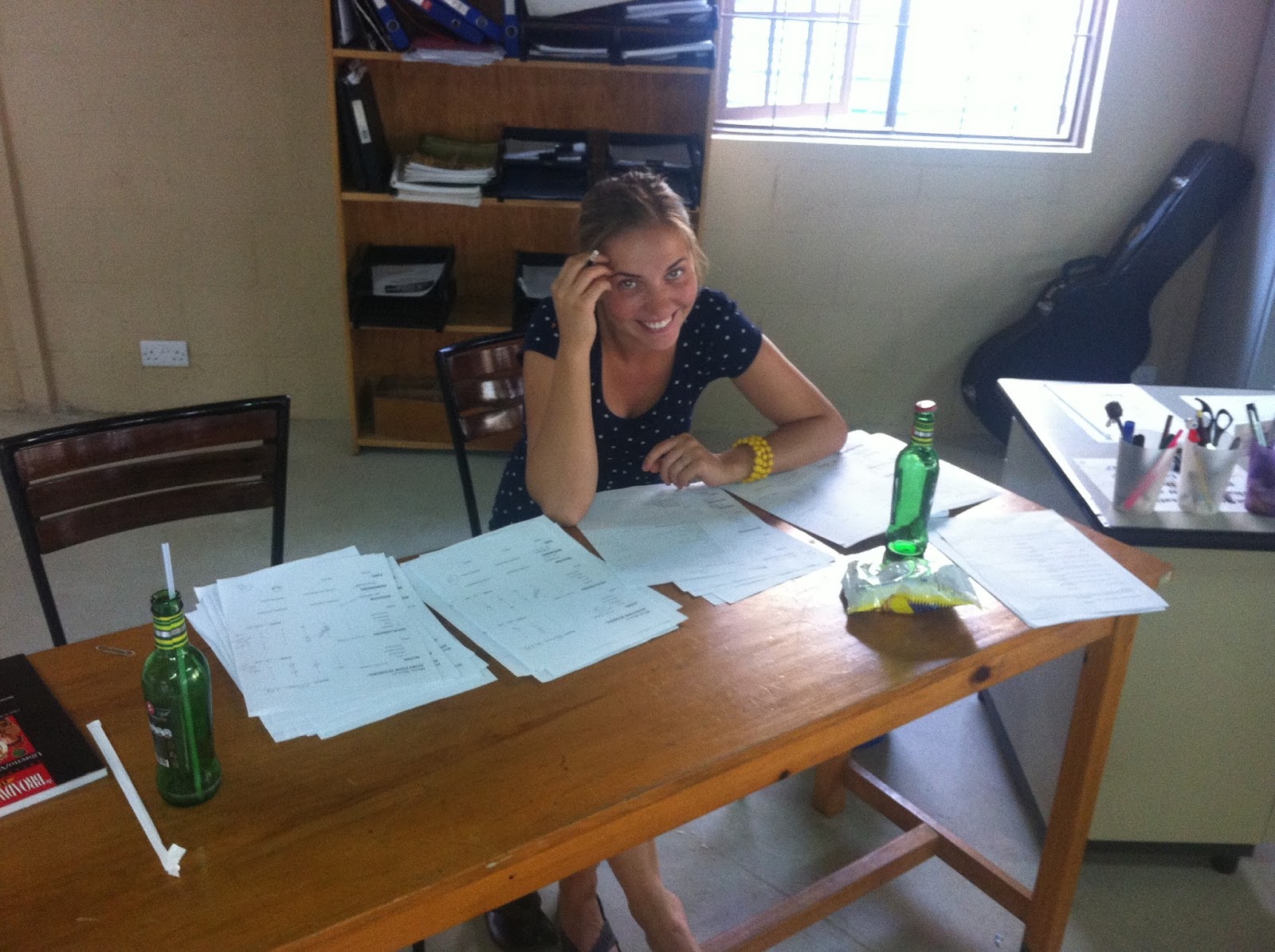
4:45 - 5:30: Grading, prepping for the next day.

Muwala interfering with a Saturday marking session ... 
5:30: Arrive back home. Feed the cat. Eat a patched-together dinner for one while watching a show. Lately, that show has been Call the Midwife, thanks to an understanding friend who sent me several seasons on a flash drive with my parents when they visited. Isaac and I often like to watch funny sitcoms when he's home, a fact that someone back in Canada found very surprising and, well, a little shallow. To be there. In Uganda. Watching TV?.... Sorry to disappoint.

Scrolling through Facebook, Pinterest and blogs ... Reading ... Sometimes grading *yech*

7:30: Turn on water heater.

8:00: Shower.

8:30: Call Isaac. Have deep conversations about paying the water bill and, could you pick up cat food and almond extract on your way home this weekend?

9:00: Lights out, bed. As much as I wish I was a more efficient human being, I need my sleep.

Once a week this routine is disrupted by attending our couples' Bible study (which, ironically, only I attend now as Isaac is in the village all week). This means I'm either going to eat at someone else's house, or hosting 25 people at my house. Sometimes I take a walk in the evening to pick up a few groceries, eyeing stray dogs warily and avoiding getting hit by bodas. About once or twice a week I hang out with one of my friends, either at her place or mine -- and my friends laugh at how I politely kick them out or politely begin to leave promptly around 8. I'm very clear -- I need my sleep. School night bedtime is not negotiable for this teacher.

This is not to complain. This is not to bore you (sorry). I love my job, I love teaching. I love teaching missionary kids and Ugandan kids that I believe will have a great influence in the future. I love supporting missionary families -- MAF pilots, orphanage directors, Bible school professors, church planters. Sometimes I feel a little restless to be out "on the front lines," sometimes I envy Isaac's life in the village (which, let me tell you, is also full of un-exciting hours -- hence his developed obsession with birdwatching), but I really feel that right now I am where God wants me to be. I believe that what I'm doing is building the Kingdom of God.

I'm sure many of you can relate -- whether your calling at the moment is raising kids or cooking at a church camp (why does that one spring to mind, I wonder?) or working at a bank or standing at a cash register or teaching at a college or cleaning people's teeth or setting up chairs before youth group. There's always the hum-drum of daily life, the mundane tasks that no one includes in a newsletter.

And it's the same over here, across the ocean in Uganda.


But sometimes the day-to-day is where I find the sweetest gems <3 


Wednesday, 8 October 2014

seeing things the second time around

In grade 6 English we're reading Hatchet by Gary Paulsen. In the novel, a young boy named Brian Robeson gets stranded in the Canadian wilderness when a bush plane flight goes wrong -- the pilot dies of a heart attack and Brian has to crash the plane into a lake. Brian has to learn how to survive with only his hatchet and the world around him.

Today in class we read Chapter 5, the part in the book where Brian, after the crash, has just come to his senses enough to stop and look at his surroundings. He sees only a blur of blue and green -- trees and sky and water. He notices a beaver lodge and the general chirping of birds, but little else. Compared to his life in the city, it seems that there is only empty silence in the woods. With hunger stabbing at him, he looks for something to eat but concludes that there is nothing. Nothing. Only brush and rock and trees and water.

By the end of Hatchet, Brian has become a part of the woods. He can differentiate between different birds, find edible plants, wake up from the slightest sounds in the night, sense the presence of animals, and predict changes in weather.

After reading the passage, I told the students to watch for the changes we will see in Brian, and as I was talking it hit me how much Brian's transformation reflects some of the adjustments I've made in Uganda.

When we first arrived over one year ago, I didn't see very much. Everything was a blur of dirt roads and sloping shacks and bodas and taxis. It sounds ridiculous, but the couple who oriented us actually had to teach us how to remember where we lived.

"Everything will look the same to you," I remember Bill saying, standing there in his khaki shorts and T-shirt, looking infinitely more comfortable on Ggaba road than us newcomers felt. "Look for those two billboards, then you'll know that's your road. Remember you live in Kansanga, past Kabalagala."

It sounds embarrassing, but for the longest time I had a hard time remembering people. The guards from the school all looked the same to me -- black men wearing the same uniform and sporting the same haircut. When our Heritage night guard would arrive in the growing darkness of evening, I would often greet them with a smile, ask how they were doing, and then turn and hiss under my breath to Isaac, "Who is that again?"

I also had a hard time with Ugandan women. I realized that my brain had learned to tell people apart by their hair. As soon as I "remembered" a Ugandan woman by her hair, she'd changed it! Tight braids could turn to shiny waves overnight. When people talked about the physical features of different tribes, I was at a total loss.

[ I should note that I am not very observant to begin with (I would make the worst witness at a crime scene). I should also note that a few weeks ago a Congolese French teacher at Heritage confessed that he got me confused with one of the American teachers for the entire school year last year. He pretty much only saw blond hair. (So I'm not the only one who struggles!) ]

When we first moved here, I got a little irritated with people saying things like, "Listen to your gut. Don't get in the taxi if it feels wrong. Use common sense."

Use common sense? I had no common sense. Getting on a boda with a strange man wearing no helmet felt wrong. Getting in an unmarked car that I was told was a private hire felt wrong. Hearing strange noises at night felt wrong. Sticking a pen in a socket to make the plug fit felt wrong. It seemed that I was constantly suppressing my gut feelings.

This year, I realize how far I've come. I don't see a row of shacks strung along a dirt road; I see a chapatti stand, a seamstress, or the place that always has good cucumbers. I look at the same Heritage guards I was confused by last year and see completely different features, shaking my head and wondering how I ever confused them. I notice that a sign has changed or a new place that sells cell phone credit has gone up. Noises in the night are no longer unnamed; I can hear Molly crying, or the Muslim call to prayer, or the ice cream man bicycling by, or the neighbour's gate opening, or a Luganda radio station playing the football match. I don't think that every day is "the same" and that the weather never changes; I find myself saying things like, "It's a bit chilly this morning." (Oh no -- what will happen when I go back to Canada?)

Slowly, I'm also gaining a bit of a "gut feeling" that I can count on, to help me sense potential danger or alert me to any changes.

Power outages? Normal. 
Random man hitting on me? Normal. Random man who gives me a totally different "gut feeling" and causes me to cross the road? Not normal. Getting in a taxi? Normal. Getting in an empty taxi? Not normal. Kids openly using the word "beaten" to describe the discipline at home? Normal. The kid next door regularly screaming for extended periods of time? Not normal. People staring for what I deem to be awkward lengths of time? Normal. Kids in ragged clothing and bare feet? Normal. Thin man in rubber boots herding cattle (with humongous horns!) in front of my gate? Normal.  Kids running up and talking to me, a stranger, and grabbing my hand? Normal. The power going out for a day? Normal. The power going out for a week? Something to talk about. Giving money to a young woman begging on the streets of Kampala? Not appropriate. Giving money to a guard who you've known for over a year when his house burned down? Appropriate.


Hail storms? Not normal. 

Using squatties on a road trip (BYOTP)? Normal. 

Cramming in a taxi and suppressing all feelings of claustrophobia? Normal. 

Even though I can sit back and realize how much more I see here, how much knowledge I've gained, I know that it's a learning curve that I've hardly mastered. Maybe that's why a part of me loves living in Uganda -- it's always interesting, and there's always more layers to learn.

Once any other kids outside of another little shop, now our friends Winnie, Flo and Comfort. 

Friday, 14 March 2014

african rain

I'm pretty sure when I was in Ghana in 2009 I had a blog post with the exact same title. There is something wonderful about rain here, a magic that is new to me.

The rain here is different from the rain in Ghana, at least during the season I was there. Every day the sun rose and the heat swelled until rain broke in the afternoon. People were forced to stop, take shelter, rest, and a rain would softly fall for about half an hour, relieving the heat, and the sky would clear again.

This is the first time I have ever experienced the end of a dry season. For two months the sun crawled across the sky every day, the dust rose off the dirt roads, and there was no cloud cover to soften the sun's searing power. For two months Isaac and I cleaned our outer ears, surprised at the blackened Q-tips. For two months Ugandan men drew sewer water in buckets and tossed it across the streets, trying to keep the insufferable dust in check. The grass got browner and the lawn developed bald patches. It wasn't terrible -- I don't think the weather here is something I can complain about! -- but after two months you realize with a start that it has not rained at all and the world feels quite parched.

Ugandans who have lived here their whole lives can't understand the thrill of that first snowfall in November, or the way Canadians take that first warm spring day as an excuse to wear shorts and sandals. After a long winter, the first time you can emerge from the house without a jacket on is a milestone.

Until now, I have not understood the joy of rain. One night Isaac and I were sitting in the living room and we heard a light pitter patter. We both froze.

"Is that rain?" Isaac said.

"Let's go watch it!" We ran out to the porch to watch the rain.

This past week we had our first rainfall during school hours since before Christmas holidays. My class was totally disrupted. The wind whipped through the windows, shaking the palm leaves outside; the clouds gathered and swirled, thunder rolled. And then the downpour began. Vicious pounding on the tin roof. The leaking tin roof, I was reminded as I watched a puddle form in the middle of the classroom. Students high-fived each other. A grade 6 boy shouted, "Thank God for the rain!" and one senior even slid down the muddy hill on his stomach.

 A friend of ours who works with Samaritan's Purse was telling me about his work in refugee camps in Sudan.

"You're much more excited for the rain when you're hungry or when you're worried about your crop," he said. "I was in a camp one time and it had not rained in 6 months."

I can't even imagine.

Today it drizzled all day. I was comfortable in jeans, a long sleeved shirt, and a light scarf; when I got home, I even wished that I had a pair of slippers! The air smells clean, everything seems washed in brighter green and the grass has already grown. Maybe after a few weeks of the rainy season we'll be done with it, but for now we're all enjoying the rain.

Tuesday, 11 March 2014

cultural fatigue


Maybe it's because we're nearing the end of third quarter. Maybe it's because Spring Break is just out of reach. Maybe it's because the hot, dry season seems to be dragging on forever. Maybe it's because I'm sick and grumpy.

Whatever the case, the past few days I have not been a very big fan of Uganda.

They -- whoever "they" are -- say that this is part of the process of culture shock. I don't remember the exact steps of culture shock, but I do know what we have experienced. Isaac and I landed in Uganda in August and were hit with immediate shock, feeling completely disoriented. I had never experienced that level of discomfort on a short-term missions trip, or even during my 3 month internship in Ghana. Knowing we were here to live for a year -- knowing we had to reach some state of normalcy here -- made those first few days totally different than someone simply visiting another country for a few weeks.

After the initial shock, I would say that there was the "honeymoon" phase. Everything was interesting. We were determined to learn the local language. I took pictures of every new thing; even the irritations were only funny quirks in our new life here.

Around December, I'd say that I hit a period where my energy started to sag. What was the point of learning Luganda, beyond the greetings I already knew? I felt homesick. My brain was tired of translating things, processing things.

And now I feel that I'm experiencing cultural fatigue. I'm sick and tired of Ugandan culture; everything seems to be wrong. Even as I type that, I correct myself in two ways: 1) I remind myself of the many beautiful things about the culture here, things I would miss if/when we do move back to Canada 2) I remind myself that, unlike Isaac, I for the most part live in a Westernized world that merely brushes Ugandan culture, compared to my full cultural immersion in Ghana.

Even so, here are some things that have irritated me lately:


  • Various cases of theft that have happened, major and minor. Someone's house being broken into while they're gone. Someone's backpack -- with a month's salary -- disappearing. Ugandans robbing poor Ugandans, rich Ugandans, rich mzugus. 
  • Being told what I want to hear instead of the reality. Me: "When can you be here?" Boda driver: "I'm coming, I'm coming. You will get there on time." Reality: "I'm really far away and you'll be waiting awhile. Oh, and you'll be late." 
  • The mini-skirt bill. Apparently this is being looked at again, but it certainly had people talking. The jist of it: wearing a skirt above the knee (even with tights) could result in arrest. Oh, and any Ugandan man above 18 had the right to arrest you -- "civilian arrest", it's called.
  • The fact that, as our neighbour quips, "nothing works here except reproductive organs." I never realized that China churns out not just Dollarama-level crap, but a whole other level of crap that gets sent to Africa. Kettles blow up, fans break, lids don't fit on containers, etc. 
  • While some people do work very hard, very long hours, seven days a week, many others seem to have a poor work ethic, particularly when they have a steady job with any kind of guarantee. Guards who fall asleep, cashiers who lean on the counter texting on their cell phones, employees that think rain is a valid reason to show up late or leave early, etc. I want to shake people and force them to sit through a customer service training session. This country has a youth unemployment rate of 60 - 80 % depending on who you ask, and yet so many seem to take their jobs for granted. 
  • Disgusting stray dogs. Specifically the one that bit me two weeks ago for no apparent reason. 
  • Lying in bed and hearing random children crying and screaming as they are being beaten. Tin shacks don't provide a lot of family privacy, I suppose, and now I have a better understanding of why these kids can sit still for so long, help run shops, cook and take care of younger siblings. 
  • A friend of mine volunteers regularly at  local orphanage. When an HIV+ baby was almost dying, she and her husband took him in temporarily as foster parents, respecting the legal process of the social workers from the orphanage. His parents -- who, by the way, tried to kill him by throwing him into a latrine -- heard about it and were upset that he was in a mzungu house. They demanded he be returned to the orphanage, because they still have rights. So he was. With his repressed immune system, his health is already suffering. In this country, the idea of temporary foster parenting is foreign; people foster to reach the goal of adoption, otherwise kids languish in understaffed, underfunded and often corrupt orphanages. 
  • I spoke to a friend of mine about cultural fatigue today and she told me that she and her husband made a list of things they're tired of running out of here as compared to Canada: Internet, cooking fuel, electricity, air time for cell phones, hot water, drinking water, etc. I ditto that. 
  • Rainwater running off into the gutter, where it simmers in the heat and forms a thick soup of garbage, human and animal waste, etc. And then when the road gets too dusty people in this dry season, people get buckets and toss that sewer water onto the road to keep the dust down. Gross. 
  • Isaac is also feeling cultural fatigue, understandably as he is the one who is actually enrolled at a Ugandan university full-time -- taking classes, doing assignments, making friends, eating Ugandan food regularly. This week he feels down and generally irritated. Professors coming late, professors not showing up at all, school schedules changing constantly, and chaotic classes sometimes make him feel like he is wasting his time. 
  • Ants. In my peanut butter jar, inside my Tupperware container. 
  • People burning grass in the field next to us, burning grass in the swamp a short distance away, burning garbage in the field I walk to on my way to work. Why? And can you at least do it when the wind is blowing away from my house?
So there. My rant is done. I'm not trying to paint a negative picture of Uganda (which I realize I just did). I'm trying to be honest about the process of culture shock, about what it feels like to be thinking thoughts you'd never thought you'd think, about being convinced that "my way is better!"

This is not a racial thing -- it's a culture thing. I'm told the next step of culture shock is acceptance and adjustment. I've also been reading some books by a Nigerian author who writes about culture shock going the other way, moving from Africa to the West, which has been beneficial. 


Needless to say, I'm craving Tim Horton's right now.

Tuesday, 25 February 2014

resting in the shadow of the almighty


Psalm 91 has become a bit of a theme for the teachers at Heritage this year. For some reason sickness has been more rampant than usual; some of the teachers seem to always have somebody in their families who is feeling sick. When the school community was going through a particularly tough time one of the teachers posted on the staff Facebook page that she felt led to pray Psalm 91 over the school. Little did she know, there were also dark spiritual battles going on at that time with a particular student who was later discovered to be deeply involved in Satanism.

This week I return again to Psalm 91. On Sunday evening I was bit by a stray dog, even though I was on the other side of the street and minding my own business. At first it seemed like more of an inconvenience than anything; being bit meant four trips to the clinic across town (over the course of the next month) to get a total of 8 anti-rabies shots. Some people back home reacted with the "Oh, too bad!" attitude that I had myself. People here in Uganda had different reactions.

The next day I got to hear stories of people here who, unable to afford the medication, die of rabies. A staff member showed me scars on his arm from when he was attacked by a rabid dog; thankfully his father had money to get him the medication, but five other people in his village died. As a Westerner, it is always a little startling to bump into something that can't be solved by modern medicine. "Wait? Rabies has no cure and is almost always fatal in humans?" (Now, the vaccines -- given promptly -- are almost 100% effective and the dog that bit me is not rabid for certain.)

Ever since renewing my commitment to regular prayer two weeks ago, I have felt mentally attacked as well. Negative thoughts, beating myself up, nightmares, feeling weary, and having people in my life do or say hurtful things seem to have popped out of nowhere. My old battle with fear and anxiety has risen up again, triggered by dog bites, school stress, and threats of terrorist attacks in Kampala.

So today I opened my Bible, first to Ephesians 6 where I'm reminded that I "wrestle not against flesh and blood, but against ... the spiritual forces of evil in the heavenly realms."

On my break I turned to Psalm 91 and read it again.

Whoever dwells in the shelter of the Most High
    will rest in the shadow of the Almighty.[a]
I will say of the Lord, “He is my refuge and my fortress,
    my God, in whom I trust.”
Surely he will save you
    from the fowler’s snare
    and from the deadly pestilence.
He will cover you with his feathers,
    and under his wings you will find refuge;
    his faithfulness will be your shield and rampart.
You will not fear the terror of night,
    nor the arrow that flies by day,
nor the pestilence that stalks in the darkness,
    nor the plague that destroys at midday.
A thousand may fall at your side,
    ten thousand at your right hand,
    but it will not come near you.
You will only observe with your eyes
    and see the punishment of the wicked.
If you say, “The Lord is my refuge,”
    and you make the Most High your dwelling,
10 no harm will overtake you,
    no disaster will come near your tent.
11 For he will command his angels concerning you
    to guard you in all your ways;
12 they will lift you up in their hands,
    so that you will not strike your foot against a stone.
13 You will tread on the lion and the cobra;
    you will trample the great lion and the serpent.
14 “Because he[b] loves me,” says the Lord, “I will rescue him;
    I will protect him, for he acknowledges my name.
15 He will call on me, and I will answer him;
    I will be with him in trouble,
    I will deliver him and honor him.
16 With long life I will satisfy him
    and show him my salvation.


It's strange how I used to read Psalm 91 metaphorically, but here in Uganda things like cobras, pestilence, and terrors in the night seem much more real. Our world is broken, and I don't believe that I have a guarantee of living in it unscathed, but I know I have a guarantee of God's peace and salvation. He alone is my refuge and my fortress -- where else can I go? 

Tuesday, 11 February 2014

first christmas abroad

For the first time in our lives, Isaac and I were not at home for Christmas. For the first time, we didn't spend Christmas Day with our parents. Familiar ornaments weren't dug out of boxes and smiled at, family functions weren't attended, and old friends didn't visit over tea. For the first time in 23 years, I didn't hang my droopy red stocking -- the same one the nurses wrapped me in the day I was born. Isaac was the only person I spent my birthday with who has known me longer than six months.

For the first time, we weren't even in Canada on Christmas Day!

Since we've been married, we've moved around. A summer in Alberta. Two years in Halifax. We're used to Skype, phone calls and mailed birthday cards. But Christmas is always a time to go home, and not going home set this year apart.

A few tips and things that made our Christmas bearable and even enjoyable, in case you find yourself abroad over the holidays:

  1. Keep some familiar traditions. For us, it was very comforting to have a few traditions from home woven into our Christmas holidays. We felt connected to our families and we didn't feel like we were "missing everything." Little things, like watching White Christmas or making French onion soup on Christmas Eve helped us celebrate Christmas. Carrying on these traditions also showed our families that we missed them and value the things that they've done over the years. One of our friends here who has children snuck a mini Christmas tree into her suitcase, and that little piece of home meant a lot to her kids when Christmas rolled around. 
  2. Make new traditions. You aren't home, so don't try to make it exactly like home. You'll only end up disappointed and depressed. Isaac and I bought a platform for a bonfire this year. We live in a third world city, where fires are allowed, and in a country that has summer weather all year long! Having a Christmas Eve, Christmas Day and New Year's Eve bonfire with our neighbours was a different way to mark the holidays. Don't try to force the place you live to fit with your Christmas plans -- incorporate things into your Christmas. Isaac and I weren't planning on getting a Christmas tree (we ended up finding a scrawny one at an expat bazaar for $7); instead we thought we would decorate a "Christmas cactus" that we could buy off the side of the road! 
  3. Be creative. Part of the fun for us this year was making do with what we have. We decorated our Christmas tree with wooden clothespins. I made a garland of paper snowflakes. A friend of ours who is here with Samaritan's Purse helped her little ones celebrate Christmas by taping a paper tree on the wall. Have fun with it! This year Isaac and I put ourselves on a budget of 100,000 UGX each ($40) to spend on each other. We each pitched in half of our gift money to have the bonfire platform made, which left us with a budget of 50,000 ($20) to spend on each other. It was fun to see how much we could get for $20 (especially in a bartering culture!) and not have the financial stress Christmas usually brings. I was impressed with how much Isaac got for $20, and how much thought he put into it. He even carved me a wooden spoon that he'd been working on when he was away at his university. 
  4. Enjoy the people around you. I have to say, my heart did go out to some of the single teachers here this year. While it pained me to be away from family, Isaac and I tried to enjoy a Christmas as a couple. I was dreading Christmas morning; I imagined sleeping in, lamely drinking our coffees after spending 5 minutes opening presents. Christmas morning was actually quite nice with the two of us, and then we headed out for a Christmas brunch at a friend's. Isaac made a point to celebrate my birthday twice with these crazy candles he had bought (they lit up like a blowtorch!) -- once at home and once at the brunch -- to make my birthday special, as my parents have always done. We have been so blessed by the amazing friends we have here, so surrounding ourselves with those people on Christmas Day was a wonderful way to celebrate. (The walk to the brunch was uphill, so it was a little strange to be sweating on Christmas morning.) If you are abroad and you don't have a good community around you, look beyond yourself and see other people that may need a connection over the holidays -- people who are alone, people far from home, people with kids who are struggling over the holidays. Invite them over and organize your own brunch. 
  5. Skype. Hm... I have mixed feelings about this one. At the beginning of December we bought an unlimited Internet package, thinking that the more Skype with home, the better! Skype was very important to me this year, but I had to be careful with it. Sometimes it would just about break me, as much as I needed to see what was going on. My mom and I did a good job of taming our emotions -- at least until the end of the Skype calls. Breathing and blinking, we'd hold our emotions until the moment passed so we never fell into a full sob-fest. Asking my mom to share Christmas pictures with me over email, and seeing Isaac's family photos on Facebook, really helped us feel connected to home. When you live abroad (at least the first year -- after that I've heard it drops off), people are so interested in seeing your world and the communication can feel a little one-way. As much as I love to dominate a conversation, I've realized how important it is for me to see the little things that are going at home, too. 
  6. Think of others. You might be having a hard time. But so are your coworkers at the international school. Wherever you are, Christmas might be a very painful time for those who have lost loved ones or those who are alone. Remember that you made the choice to live abroad, but your family back home has still lost something. 
  7. Remember what you are celebrating: Christ. Cherish the opportunity to have those "extras" stripped away -- wonderful things like tradition and family and parties and friends -- to focus on Him. There is nothing wrong with those things, but there is a silver lining in having none of it to hide behind. 


cheese please

How to make a simple goat cheese in Uganda:

One of the things we miss the most here is good cheese! A lot of what you find in stores (if you find any!) is rubbery and tasteless. If you do find the rare good cheese, it is very expensive. I have never made cheese before, and I was a little cautious of trying it because it sounded so complicated: rennet, cheesecloth, cheese press, waxing the cheese ... huh?

I came across this very simple recipe for goat cheese that didn't require rennet, only lemon juice: http://www.seriouseats.com/recipes/2010/02/how-to-make-goat-cheese-recipe.html  I followed the recipe almost exactly except that I put in extra lemon juice, because the lemons here seem to be less... lemony. 

Step 1: Find goat milk. There are goats everywhere -- everywhere! -- but if you ask anyone about goat milk they look at you funny. I looked it up, and there is a guy outside of Jinja who is one of the few dairy goat farmers in the country (probably in East Africa!) He's made a little business for himself with his herd of dairy goats, and is trying to make people aware of the benefits of goat milk. A supermarket within walking distance (sometimes) carries his company's goat yoghurt and goat milk. One day I was lucky and they actually had jugs of goat milk in the fridge!

Once you have the goat milk, the rest is easy. There's probably half a dozen ladies on my street who sell lemons, I borrowed a thermometer from a friend (couldn't find that in stores -- but if you don't have one, I wonder what would happen if you just heated up the goat milk on a gas stove for 20 minutes like I did?), and from what I hear cheesecloth can be substituted with many different materials (even read that clean handkerchiefs work). My neighbour had cheesecloth, so I borrowed his.

The final product: goat cheese! I added some garlic, salt and a bit of rosemary. I found I liked it better the next day, after I had pressed it together and left it in the fridge. It was good, but I'm still tweaking it to try to make it creamier. It was very good with spaghetti and mango salsa, but I'm still not confident enough to serve it on its own! For a first try, it was a success.