Search This Blog

Saturday, 28 September 2013

jigger clinic

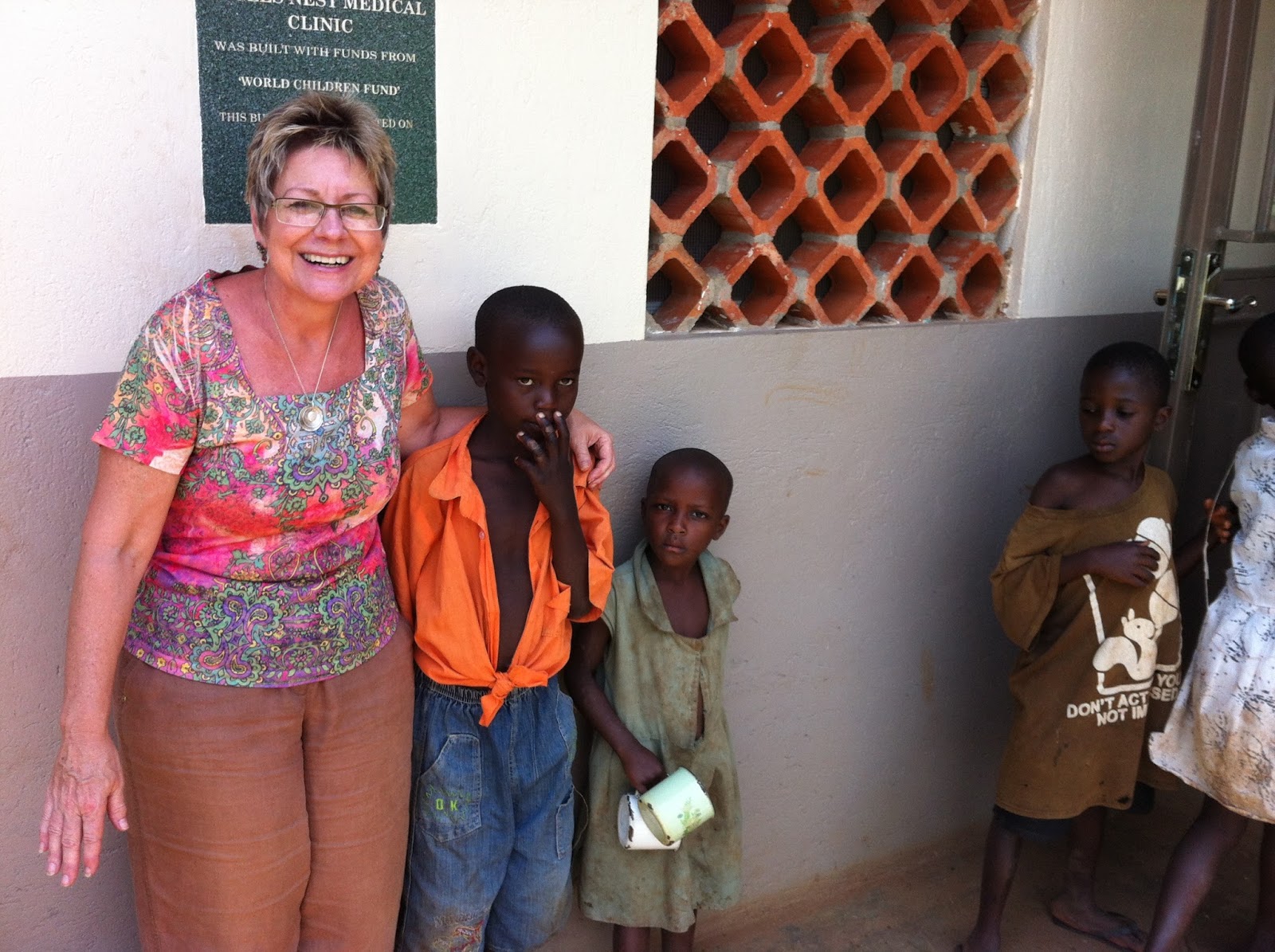
Stephanie with kids waiting to get jiggers removed. 
Today we had the pleasure of meeting a wonderful missionary couple, Stevan and Stephanie, who live on an island on Lake Victoria. They are busy ministering to the people in the village around them in so many ways.

On the same property as their home, there is a medical clinic whose primary purpose is to be a birthing centre for the area, since so many mothers and babies in the community were dying in childbirth. They also support the school that is nearby, providing a breakfast program that, the school headmaster tells them, has totally changed the kids during the day. The students are alert and they now play after school until dark -- something he had not seen the children doing when they were coming to school hungry. In the summertime they run a Saturday feeding program. There are plans to begin a wool-dying centre to teach the women in the area a trade, as well as a woodworking shop for the men. The list goes on ...

In their sixties, this couple came to the village in January. They served as pastors in California for years. Although Stephanie always felt called to the mission field, her husband was adamant that he "was a pastor, not a missionary." On a short term missions trip to Uganda in 2010, Stevan literally heard God calling him to serve as a missionary while driving through the Kampala slums. Within three months they had miraculously raised enough money and were back in Uganda.

Since coming to the village they have faced their fair share of hardships. They have had malaria twice. They have watched the cost of projects creep way past the initial prediction. They have learned to trust God, and have watched God provide money month by month. They have transformed the un-livable little mission house into a cozy home [even though they still don't have electricity].

And yet they have such a wonderful attitude. They were both so bright and welcoming, and wanted to hear about us. Instead of going on about the troubles they've had, they were eager to tell us about the Muslim woman who gave her heart to Jesus last week; after delivering her baby at the clinic, the woman demanded to know what religion they had -- whatever it was, she wanted it to! It was clear that, in spite of all the frustrations they've had, they are fixed on their true purpose: to share Jesus.

The particular reason we were there today was to help with their monthly jigger clinic for the surrounding community. What are jiggers, you ask? As I understand it, they are small flea-like creatures that burrow into your skin and lay sacs of eggs. They are painful, and if left untreated they can become infected and actually cause death. People get jiggers by having dirt floor in their homes; the dry, dark environment is the perfect breeding ground for jiggers. Each month Stevan and Stephanie run a jigger clinic. The Ugandan nurse (who will soon be leaving to train as a doctor) hands out educational pamphlets in Lugandan to teach the people how to prevent jiggers. The children's feet are washed, jiggers are dug out, the wounds are cleaned, and band-aids with cartoon characters are applied (a thoughtful donation from a church in the States!)

After having coffee and banana bread with Stevan and Stephanie, some of the men in our group helped put a roof on the small shelter that they use to run their feeding program. The rest of us played with neighbourhood children, waiting for our jigger clinic patients to arrive. Finally we realized that most of the kids playing with us had jiggers, so we began washing feet and digging out jiggers [okay, let's be honest -- I only washed feet! The description of a white sac of eggs that usually breaks open during removal and leaves a hole turned my stomach!]

Isaac helping fix the roof, and telling me not to take his picture :) 
Most of the kids spoke little English, which made it a little difficult to give instructions. It also explained the initial miscommunication: the kids that we were playing with had probably been sent by their parents to get their jiggers removed, but they had decided they would rather play and we didn't realize they were the jigger patients we were waiting for. Somehow, though, between our scraps of Luganda, their scraps of English, and other kids who acted as translators we got the basic messages across and a few jiggers out before we left.

Most of the time we were there, though, we didn't need a whole lot of English. Frisbees, soccer balls, smiles and bubbles don't require a whole lot of translation!

Babu: A seven yeard old boy I had played Frisbee with (scary thought: me teaching someone else how to Frisbee) and practiced English with. He had jiggers and fungus. I washed his feet (with gloves!!!) so that he could get the jiggers removed. 

Thursday, 19 September 2013

grade 7 devotions

Since Heritage is a Christian school, part of my duties as the grade 7 homeroom teacher is to lead them in a 15 minute devotional every morning. On one of the first days I was here I asked them to anonymously write down topics or questions they have that they would like addressed in devotions this year. Here are some of the responses:


  • (a single word in carefully folded paper): angels 
  • Who brought homosexuality to the world? 
  • What does the Bible say about the Sabbath? 
  • Why did God get angry and kill so many people? He was supposed to love everyone and WE are SUPPOSED to follow his example. 
  • I thought a Bible is full of God's words and it talks more about God's kingdom only. But why is it that in Song of Songs, its really full of love things? And why is it that God uses people who do wrong things instead of doing good things? Where is heaven? 
  • How did people learn to write? [huh???] 
  • About not being a fan but a follower.
  • About God's love 'n' grace.
  • How old was Jesus when he died? 
  • How does hell look like?

Fifteen minutes in the morning, after scrambling around to prepare for lessons: Go! 

We're going to start reading Andy Stanley's Since Nobody's Perfect ... How Good is Good Enough? which the grade 8 homeroom teacher recommended. Maybe that will be a good start ... 

Wednesday, 4 September 2013

perspective

Isaac is away at Uganda Martyrs University tonight, where he has a dorm room. Thankfully his classes are aren't scattered throughout the week, so he'll only be gone for two nights a week. I realized suddenly that, although only about an hour's drive apart, we're in different hemispheres :) The equator cuts right across the highway he takes on his route to school.

Another bit of perspective I got tonight: I was walking along the dirt road we live on to pick up yogurt, milk and a phone calling card. I bought yogurt and milk (a small amount, in a bag) and the total was 4300 shillings. 1000 shillings is about 40 cents American. I pulled out a 10,000 shilling note (the equivalent of 4 dollars American). My change should have been 5700, or a little over $2.

This small shopkeeper did not have $2 in change. He asked me to please wait a moment while he left and went to other shopkeepers asking for the change.

You realize how little people live on here when $4 is a big bill to break ...

Wednesday, 21 August 2013

teaching: week 1

Tomorrow will mark one week since the school year began. I can already tell that time is going to fly, and in about two seconds I'll be saying, "Have a good October Break!"

[Yeah, that's right fellow Canadians ... we get a week off in October and a Spring Break -- keep in mind school started on August 15!]

My first week as a real teacher ... In the calm before the storm, I carefully tried to decorate my classroom and organize myself. Greeting parents and students, introducing myself as "Mrs. Shelley," on that first day felt very strange. Almost an out-of-body experience. A part of me felt like I could better relate to the nervous, skinny middle school student in the desk than to the seasoned teachers in the staff room.

Since then, I've allowed the whirlwind that is made up of three middle school grades rip through my carefully set up classroom. In only a week, they've broken it in and made it feel like a proper classroom -- a mixture of organization and chaos.

I teach the following four classes: grade 6 Language Arts, grade 7 Language Arts, grade 8 Language Arts and grade 7 World Geography. I also have the grade 7 class for morning devotions and advisory (a study hall period at the end of the day). They are the group I spend the most time with; they are fun, they are loud, they are antsy and there are more boys than girls. I'm already rearranging lessons and units to make them more hands-on! (Salt dough maps, here we come!)

So, who are the students that sit in front me every day?

I am amazed at how truly international this school is. During teacher orientation I was already impressed: my colleagues come from the States (Alaska to Florida!), Canada, the Netherlands, Congo, Uganda, Sudan, and the UK. I have students from literally all over the world -- the Philippines, India, Korea, Canada, America, Europe, Australia, Ethiopia, South Africa, Colombia, South Sudan, and Nigeria.

My students speak French, Spanish, Danish, Arabic, Korean, Luganda, Swahili and a host of African languages I had not even heard of. (When I asked the question: "What languages do you speak or understand?" some of them had to stop and count on their hands to keep track!)

Besides where they are from, my students have been all over the world. I asked them to write down the places they've lived, not just visited, and I couldn't believe how many countries some of them have experienced at such a young age. Their social backgrounds and reasons for being here are very different. Some are here for the Christian foundation, others are here for the academics. Many come from missionary families, while others are from prominent Ugandan families.

Some of my students' parents work for NGOs, while others work for international companies. In one class two boys (who had some of the longest lists of "places lived" -- including hotspots like Kosovo, Rwanda, Sudan, Somalia) shared that both of their fathers work for the UN.

[Yay -- I get to teach them World Geography!]

My students also come from different academic backgrounds. Many of the missionary kids have been at least partially homeschooled, and the children from around the world all come from different academic systems. I've had one student tell me he read Macbeth in grade 7, while other students -- refugees from neighbouring African countries -- have had little formal schooling.

Wherever they are from, all of my students are, above all, middle schoolers. They are awkward, funny, emotional and goofy. They are stressed about their homework and obsessed with what their peers think. They are pressured by parents, pushed around by older siblings, and have power over younger siblings. When asked to anonymously write down topics or questions they would like addressed in devotions, the boys snicker and giggle and hint at a "certain three-letter topic."

...They also stink after gym class.

Yup, at the end of the day they're all just middle schoolers.


Monday, 19 August 2013

that time all the teachers got sick

Well, it's hit. That moment that Uganda stops shaking your hand and gives you a punch in the stomach. Literally.

We all knew it was coming, and that it would probably be within the first month. Our bodies have bravely faced all the new germs and the different climate, water and food. Besides a bit of adjusting, over the past two weeks we have remained medically stable.

But our bodies just realized we're not on a two-week missions trip. Our bodies seem to have declared a mutiny.

Over the past four days teachers have been dropping like flies. My turn came on Friday evening. I felt fine after the first two days of school and a group of us were heading out to a local restaurant to celebrate the end of our first "week." As we began walking, I felt occasional twirls in my stomach but there was no major discomfort until after we had eaten.

By the time we got back, let's just say I was in a hurry to get home. My upset stomach persisted through the night, and I was up at least three or four times. While I wasn't surprised by an upset stomach, I was troubled by the sharp spasms of pain I was having in my middle and upper abdomen. They would only last a few seconds, but they would take my breath away. On Saturday morning, as it wasn't getting any better, I mentioned it to Terri, the school's go-to woman for any teacher troubles. (She's fantastic!)

Terri arranged a drive for me right away to get me to the Surgery. What is the Surgery, you ask? Good question. One of the first days we were here, Isaac and I were shocked to hear Terri say: "And if you get sick, we'll take you straight to the Surgery." A little drastic, we thought. I guess it's a British thing to call it "the Surgery" -- it's simply the name of the medical clinic in the area.

[Warning: next paragraph may be considered oversharing.]

Long story short ... I went to the Surgery, I was told I had to produce a stool sample, I couldn't bring myself to produce a stool sample (despite all my problems in the previous 24 hours, and despite the squats Isaac suggested that I do), I went back the next day with a sample ... Turns out there was a bacterial infection in my guts. When your immune system is depressed, due to stress or jet lag or being overwork, the natural balance of yeast in your intestines can get out of whack. So ... problem identified, problem solved (or so it seems at this point).

Today at school (Monday) I felt fine but a total of six teachers were out. Several of them had almost the exact same experience that I did. Although Heritage has a substitute system (and a very flexible principal who can jump into almost any class), because people were dropping during the day things got a little out of hand.

At one point I was sitting in my room about to enjoy my prep period when a fellow teacher poked her head in on the way to her class: "Hey, do you have a class now?"

"No, why?"

"Uh... the grade eights are sitting in the science lab without a teacher. Do you know who's subbing?"

"No, but I'll go look."

I went and looked. No one to be found. So I taught science :) Good times. One of my high school teachers must have done something right, since so much came back to me. DDT, concentration up the food chain, acid rain ... oh yeah, I was in the zone. (not).

At the end of class one of the students thanked me for the wonderful lesson. (Okay, I have to tell the whole truth --  he's a new student and apparently he thanked all of his teachers after every lesson.) Another student told me I'm a good science teacher. I told her not to tell anyone else that!

Here's hoping that everyone else is on the mend.


Wednesday, 14 August 2013

good question

Last week we went to Calvary Chapel in Kampala, along with fellow teachers from Heritage who attend there.

The music was amazing, the service was good. A little long, a little hot ... I won't lie to you! I'm also not sure that navigating public transit downtown on Sunday really preserves it as a day of rest. Since we have such a strong Christian community in Heritage, we think we might church-hop a bit to check out the scene here in Uganda. Next week: Watoto!

The pastor at Calvary Chapel posed a good question, though, which continues to return to my mind:

"Does your life make anyone hungrier to know the Lord Jesus?" 

Hm ...

videoclip: walking the pipeline


The shortcut to the Super-Super market -- walk across the swamp via the pipeline! I admit, the walk doesn't look that scary ... a nice thick pipe, not too far up ... what's the worst that could happen?

Well, perhaps the photos below will help you understand why I'm a little nervous about falling off the pipe and into the swamp: Here's a shot of Wayne, the science teacher, holding up something he found in his science room: a black mamba snake preserved in a water container. Although this one's dead, apparently live ones -- along with their friends green mambas and even cobras -- have been found on school grounds, staff compounds, and especially the swamp.