Search This Blog

Monday, 2 October 2017

love warrior - quotes from the book

Quotes from the book Love Warrior by Glennon Doyle. Don't agree with Glennon on everything, but she is a beautiful writer and gives a lot of truth to chew on. A very thought-provoking book!

Chapter 1 

[in high school, in the cafeteria at lunch]
"Before I take a step forward I wish vehemently that we had assigned seats. I look out at the sea of faces and understand that we are all drowning in freedom. Where are the adults? We need them here."

[in the hospital being treated for bulimia]
"One day a girl with sliced-up arms says, 'My mom sent me here because she says no one can believe a word I say.' I look at her and I want to say: Does she see that you tell the truth on your arms? Like I tell the truth in the toilet? By the time we landed in the hospital, most of our families considered us insensitive liars, but we didn't start out that way. We started out as ultrasensitive truth tellers. We saw everyone around us smiling and repeating 'I'm fine! I'm fine! I'm fine!' and we found ourselves unable to join them in all the pretending. We had to tell the truth, which was: 'Actually, I'm not fine.' But no one knew how to handle hearing that truth, so we found other ways to tell it. We used whatever else we could -- drugs, booze, food, money, our arms, other bodies. We acted out our truth instead of speaking it and everything became a godforsaken mess. But we were just trying to be honest."

"The hidden, truest rules about how to matter as a girl are: Be Thin. Be Pretty. Be Quiet."

Chapter 4 

[on the bathroom floor, facing an unexpected positive pregnancy test]
 "...I get stuck on that phrase as it runs through my mind. Free for all. Maybe grace is free. Free for the taking. Maybe it's even free for me. This free-for-all overwhelms me, fill me, covers me, convinces me. I decide to believe. Something in me says yes to the idea that there is a God and that  this God is trying to speak to me, trying to love me, trying to invite me back to life. I decide to believe in a God who believes in a girl like me.
"The God I decide to believe in is the God of the bathroom floor. A God of scandalously low expectations. A God who smiles down at a drunk on the floor, wasted and afraid, and says, There you are. I've been waiting. Are you ready to make something beautiful with me?"

[realizing the difficulty of getting sober]
"This is the difference between God and booze. God requires something of us. The booze numbs the pain but God insists on nothing short of healing. God deals only with truth and the truth will set you free, but it will hurt so badly at first."

Chapter 6
[holding her baby for the first time]
"I am this baby's mother. He is mine. I am his. He is the key I've been waiting for my entire life. I am unlocked. Chase and I belong to each other."

Chapter 7 
[reading people's responses to her honest Facebook post]
"I marvel at the honesty and pain. Many messages are from people I've known for years, but I'm discovering that I never really knew them. We've spent our time together talking about everything but what matters. We've never brought to each other the heavy things we were meant to help each other carry. We've only introduced each other to our representatives, while our real selves tried to live life alone. We thought that was safer. We thought that this way our real selves wouldn't get hurt. But as I read these messages, it becomes clear that we are all hurting anyway. And we think we are alone. At our cores, we are our tender selves peeking out at a world of shiny representatives, so shame has been layered on top of our pain. We're suffocating underneath all the layers."

Chapter 9
Types of listeners to the news of her marriage -- the Shover, the Comparer, the Reporter, the God Reps, the Victims, etc.

Chapter 10 
"The surf continues to hit the sand rhythmically and dependably and I trust it will continue. The sun is setting but I know it will rise again tomorrow. There is a pattern to things. This makes me wonder if I can also trust that there is a pattern, a rhythm, a beauty, a natural rise and fall to my life as well. I wonder if the one holding together this sky might also be capable of holding together my heart. I wonder if the one making this sky so achingly beautiful might also be working to make my life beautiful, too."

"I don't know how to fix my marriage. All I know is that I need to tear down my own walls and face what's underneath . . . I look out at the sea, up at the sky, and down at the sand. I think, I can be brave enough to tear myself down -- because the One holding all of this together will hold me, too."

Chapter 13
"It strikes me that it's always the most religious people who are most surprised by grace . . . We sweep up our mess and hide our doubts, contradictions, anger and fear before showing ourselves to God, which like putting on a fancy dress and makeup to prepare for an X-ray."

"We are all desperate for reunion and we are trying to find it in all the wrong places. We use bodies and drugs and food to end our loneliness, because we don't understand that we're lonely down here because we are supposed to be lonely. Because we're in pieces. To be human is to be incomplete and constantly yearning for reunion."

"Fear doesn't make perfect love untrue any more than passing clouds make the stars untrue. I know how to find my way back to truth, to love, to peace, to God again. All I have to do is be still and breathe and wait for the clouds and fear to pass."

Chapter 15
"But what the hell does sexy even mean? I wonder if the word sexy is everything that made sex a lie to me . . . Sexy was one type of body and one color of hair and spending an entire life looking into the mirror instead of out at the world . . . I'd been trying to be that kind of sexy for twenty years, and I realize that's going to have to change. That definition of sexy is what poisoned my husband and me and it's never going to work for us again . . . Maybe I can find my own sexy."

"Women who are concerned with being pretty think about what they look like, but women who are concerned with being beautiful think about what they are looking at. They are taking it all in. They are taking in the whole beautiful world and making all that beauty theirs to give away to others."

"I consider the possibility that I've been right and wrong my whole life. I was right to want to be beautiful and sexy; I was just wrong to have accepted someone else's idea of what those words mean. It strikes me that I need to throw out the dictionary the world gave me about what it means to be a mother, a wife, a person of faith, an artist, and a woman and write my own."


Unsure which chapter ...

"Be brave because you are a child of God. Be kind because everyone else is, too." 


Monday, 23 January 2017

People Like Us - Quotes

I just finished reading People Like Us by Joris Luyendijk, a former Dutch news correspondent to the Middle East. While the style of the book is easy to read, the concepts are thought-provoking. Luyendijk reveals the inner workings of the international news machine, and reflects on how the Middle East in particular is often misrepresented and misunderstood in Western media. Note to self: read his other book, Hello Everybody! 

Some quotes ...

"I had always thought that the 'news' was a compilation of the most important things in the world. But after six months as a correspondent, reality set in. News is only what is different from the everyday -- the exception to the rule. With an unknown world like the Arab one, this has a distorting effect. When someone is shot on Dam Square in Amsterdam, it's news, but Dutch people know that people aren't normally shot there. They've been there themselves, or they know someone who went there and returned safely. But how much do Dutch people know about daily life in the Middle East? . . . If you are told only about the exceptions, you'll think they are the rule." (37)

"Dictatorship itself is the most important thing to report about in the Arab world . . . Writing 'around' this was like reporting on France or the Netherlands in 1943 without mentioning the occupation."

"Did the hundreds of thousands of anti-war demonstrators in Europe know what Saddam did to his subjects? I was not aware that many of the demonstrators thought anything other than: 'Of course dictators are bad, but war is really horrible, so we're against it under any circumstances --- Peace, man!' I'd say dictatorship is war, too; a regime's war on its own people." (214)

"The borders of the Middle East had been drawn by foreign, largely European, powers at the end of the First World War in order to facilitate their domination of the area." (quoting Henry Kissinger in Diplomacy)

Saturday, 2 January 2016

a light shines in the darkness


Over our Christmas break this year, we spent five days on a trip to Nakivale Refugee Settlement in western Uganda. Needless to say, it was an incredible experience that I believe has deeply impacted both Isaac and myself. I'm sure I will write more about that experience in the future.

While not everything was planned ahead of time, it became clear in advance that we would be expected to speak to some church leaders to give an encouraging word and to clarify our connection to them as fellow Christians. ("Many Africans think whites don't believe in God," we were told. Wonder why???)  I was also told that I may be asked to share some encouragement with Christian women specifically, knowing that many of the women and girls in the camp had been victims of sexual violence.

In the weeks leading up to the trip, I was anxious about these possibilities. Teaching English? Yes, I can do that. But giving a spiritual word of encouragement to a group I don't know, across cultural and language barriers? I kept saying, "Well, I'm not a pastor..."

Deep down, there was an added layer to my insecurity. How can I stand before a group of refugees, people who fled from their homes and in many cases have lost everything? What would they think of this little white girl, so oblivious to true suffering, giving them an encouraging pat on the back? How could they hear the Gospel as they sit in difficult situations that may not change?

In Western culture, one of the greatest arguments against the Gospel is suffering. It's become a trump card in the argument against the existence of a loving God. In the West, a single encounter with loss can shatter a person's faith and send them teetering right off the fence and away from God.

And there in Nakivale ... that whole group would be a testament to the suffering and evil in this world.

It wasn't a conscious thought, but it was an undercurrent in my mind.  Hmm... how do we flex the Gospel to fit this group? How do we face those difficult questions? What angle do you take with such a group?

It sounds a bit silly when I type it out, but the thoughts were there. And those thoughts, I realized, are so misplaced. The Gospel was made for people in suffering.

Yesterday I was flipping through the Bible and landed in the latter part of the Psalms. Not psalms of David, but psalms penned by Jews finding themselves in Babylon. Away from their home countries. No hope of return. They'd lost everything. And then I found another bookmark in Isaiah. Passages about a God who is fiercely angry on behalf of the oppressed, who sides with the suffering and sets himself against the unjust. And then there was another bookmark, a wrinkled church bulletin shoved in the New Testament. Letters from Paul. The author, a persecuted man who eventually lost his head for the sake of the Gospel. The audience, a church well-acquainted with violence and loss of freedom.

And then there's Christmas. The story of a God so grieved by the brokenness, the sin produced by the will of fallen humanity. A God so moved by our suffering that He stepped into it, taking on flesh and knowing poverty and pain and death for our sake, that we might be joined with Him when He returns to make all things right.

The number of people in the Bible who experienced pain, poverty and loss far outweigh those who lived a smooth life, especially in the New Testament. If anything, as someone who has had very few storms in life thus far, I am the outsider. I am the one who doesn't entirely "get it." As a member of a privileged part of the Body of Christ, yes -- we have a responsibility to help in practical ways and to "spend ourselves on behalf of the hungry and oppressed" (Isaiah 58:10). But we do not need to be ashamed to present the Gospel, even if on that day that's all we have with us to give. 

This Christmas my sister's church had the congregation sit in darkness, and then as reader after reader read a different verse about light, a lamp was turned on. Eventually, the room was filled with light. Light shines best in darkness. 

Christianity is not a religion of the prosperous, the privileged. God has been a shield and source to the oppressed for thousands of years. Christ himself is no stranger to suffering. We don't have to twist the Gospel or wonder how it will be received by those in difficult situations -- it was meant for them! Our hope is not fragile, it is not breakable, it is not stumped by the darkness in this world .... It shines fiercely in the midst of it. It cannot be put out.


Wednesday, 2 September 2015

bits of braeside

In my grade 7 English class students read "Where I'm From," a poem by George Ella Lyon. The poem is basically random scraps of memory from her childhood -- different sights, sounds, tastes and feelings. Together, they make an interesting picture. Students have to write their own "Where I'm From" poem, and it's always interesting to read what they share.

I've done this for three years, but haven't written my own yet! Last night lying in bed I decided to do my own English assignment and write a poem about summers as a kid at Braeside camp. It was fun to remember the details, and each one brought back even more memories!


Where I'm From

I am from the churning of pedals
Rubbing of bicycle wheels on the grass.
From the endless Pool Hill and
Riding with no hands
From fresh red scrapes and
Wrinkled white spots
The scars we wore like medals.

I am from one-piece bathing suits and
Slippery brown bathroom tiles.
From pool noodles as horses and
Swirling rounds of ankle tag
From warm puddles on concrete and
Cold cannonball splashes
Wet shadows stretched out and
Disappearing in the sun.

I am from powdery sidewalk chalk
Bumps on my knees
Creaking of swing chains and the
Thump of shoes on park sand.
From Fudgsicles fringed in ice and
Small cuts in the corners of mouths
Sucking the last juice from
Rolled-up Freezies.

I am from tan lines and
A riot of freckles
From bleeding, wrinkled toes.
I am from knotted hair shaded
Green
And streaked white by the sun.
From thin legs stretching from shorts and
Sandals left at the door.

I am from dripping ice cream cones
And sticky marshmallows
Tasting of smoke
From burgers and buns and
Crackling candies --
Fireworks in my mouth.
From paper bag penny candies and
Cereal bowls on the porch.  

I am from contests
From hold-your-breath to
Mouths stuffed with sour candies to
“I see Braeside first!”
I am from watching the big kids and
Beating the little kids –
The middle ones know the taste of
Winning and losing.

I am from the pop of a bonfire
The spell of the
Jumping orange flames.
From “White rabbit! White rabbit!”
To drowsy jokes and secrets
From pit after pit
Circles of murmured conversation and
Separate memories
Flecks of fire
Sprinkled under the stars. 

Sunday, 3 May 2015

hats off to missionary moms

During the past two years, I've had the chance to observe an interesting group of people: missionary moms. I realize that they are all different, but there are certain patterns and characteristics that put these women in a league of their own. 

To be honest, I initially found missionary moms to be a scary group. Last year I was a brand new teacher, fresh out of university, and although my parent/teacher interactions were very positive, it was still a source of insecurity. There was a particular brand of parent known to be feisty: missionary moms. You could often expect direct questions, honest impressions, and a distinct feeling that you weren't completely trusted when one of these ladies sat across the table from you. 

But over the past two years, I've grown to admire this group of women. Their husbands are often the ones who inspire a lot of praise -- pilots, doctors, pastors, directors, Bible school professors. (Although, make no mistake, I've met a lot of professional missionary moms, too -- from doctors to reverends.) But behind these men are women who are busy steering the ship of their families, protecting and watching and nurturing. 

The reason I found these moms so scary is the same reason that I admire them: they're a feisty bunch. They don't play games. When they meet a young new teacher, why should they trust them? Their kids have probably had new teachers dozens of times, and they are protective over their children's education. 

There are several moms who have fought to be able to adopt kids and teenagers, and then constantly fight to bring those kids up to speed academically.  

There's a mom who made a commute of one hour every day in horrible Kampala traffic to get her kids to Heritage, because she knew the kids loved the school and that it was good for them to connect with others. 

There are moms who learn how to drive here. Period. (Something I still can't imagine doing.) 

There are moms who camp with their children for several months in the summer while they travel and fundraise for their mission. 

There was a mom who accidentally hit a boda, found her vehicle surrounded by a mob and dozens of boda drivers, who had to lock her doors and pray while driving straight to the police station. 

There are moms who send me messages or meet me in person asking for advice, the concern for their child whose friend has moved or who is preparing to return to the States etched on their faces. Like moms of all teenagers, they sometimes can't get information out of their kids but want to know that they are okay. 

There are moms who drop their kids off at university and then return to their post on the other side of the world, trying to send care packages or arrange a place for them to stay over Easter. 

There are moms who choose to work outside the home, trying to decide on the best child care option in a foreign culture. 

There are moms who choose to stay home with young children, which can be isolating and difficult in one's own country, never mind a new place. 

There's a mom who posted that her husband, a pilot, will be gone on assignment for one month. She wrote that this is "where they shine" -- she loves to hold down the fort while he is away doing ministry! 

For some moms, accepting a particular post means that they need to figure out how to homeschool their children. 

There are moms who run cooking classes or job skills training out of their homes. 

There are plenty of moms who live abroad with special needs children (biological or adopted). They are constantly smoothing out the path for these kids, making sure that they get what they need. 

There are moms who walk to the market and barter for their family's groceries. 

There are many moms who fight the corrupt electricity company tooth and nail! 

There are moms who kill rats, shrieking with terror, while their husbands are away.

There are moms who pack the birthday candles and banners a year in advance, to make sure that their child will have a special day. 

There was a mom who had to comfort her child, watching them have nightmares and anxiety, because of the riots and upheaval they had witnessed during an election. 

There are moms here who have a very strange sense of humor. So-called 'funny' anecdotes include -- "Remember that time we were bathing the boys and little worms popped out of their heads that had been buried in their scalps?" Or -- "One time we were in a village in Tanzania. Two [of seven!] kids were sick, and we had to use a bucket because it wasn't safe to go outside. They were puking and having diarrhea in the same bucket!" 

Every mom seems to know how to cut hair (is that included in missionary training?). 

I've learned that the moms seem to be the ones who know the ins and outs of international medical insurance. 

There are moms here who really know how to stretch a shilling to keep their families healthy and happy.

There are moms who sneak a mini Christmas tree into their luggage to give their kids a small taste of home when the holidays arrive. 

There are moms here who have to explain what Wal-Mart is to their six-year-old, realizing with a start that their child is separated from their own home culture. 

There are moms who have to return to their home country alone, for months at a time, to receive medical treatment for a disease contracted here. 

There are moms who give birth here in Uganda and raise babies far away from friends and family. 


And the stories I hear from the kids! 

"Yes, one time robbers threw poisoned meat over our wall and our dogs died." 

"Once I was bit by a snake." 

"Here's some photos of when we lived in Chad..." And I see the family standing, surrounded by desert, with their daughters who were so ... little. 

When the kids share stories, I have to wonder about how the mother felt who was on the other side of that experience. 

I've come to view missionary moms with admiration, a bit of awe, and a touch of questioning their sanity. Sometimes I find them intimidating, as I don't often see a chink in their armor. If I don't hear it from them, I often hear about their humanity and their struggles from their kids.

"When we first moved here, my mom cried all the time." 

"After we left the last place we lived, and came to Uganda, my mom felt really lonely." 

They are human. They can be lonely or depressed. They battle inner fears, not just external challenges. I can tell by the way some of my students talk that their mother is the strongest presence in their lives, and her ups and downs are the thermometer for the whole family. 

Missionary moms are often accustomed to people walking in and out of their lives. This second year of teaching, I've been able to build on the foundation from last year. I've forged new friendships and, once their trust is earned, I've discovered that missionary moms can be the greatest encouragers. They are beautiful and godly, but they aren't passive or merely "nice." They are strong and tenacious, relentless in the pursuit of their call to missions and their responsibility to their families. 

So ... hats off to missionary moms! 


Friday, 27 March 2015

the exciting life of a missionary

As I scroll through my Facebook timeline and my old blog posts, I realize that my life often looks ... strangely interesting. Now, of course everybody's life looks more interesting on Facebook. When we scroll through newsfeeds, we all forget that every post means someone was hunched over staring at a screen.

Documenting the mundane: *someone* (who will remain nameless)
 cannot seem to get the clothes IN the basket. 
But I live in Uganda, and most of my friends do not. On top of that, we recently became "official PAOC missionaries" when we felt we should stay in Uganda after my husband finished his degree (not the original plan!). So, through Facebook and blogs and newsletters, we do paint a picture of life here for people who are back home. Even more intimidating, we strive to send honest "dispatches from the mission field" to people who now support us as missionaries.

Last summer when we visited Canada, I was caught off guard when a few people asked brightly, "So, how was your trip?"

My... trip?

"Where is your tan?!"

Uh ... I work in a classroom every day. It's really not ... Well, it's not that exciting.

I'm afraid there has been some miscommunication, and I'm afraid that a lot of it is my fault. Pictures of exotic birds and monkeys and landscapes can paint a life full of adventure and non-stop novelty. Photos of ministries or volunteering opportunities, along with moving stories, can -- although honest and accurate -- cause people to think that I feel rewarded every day, tangibly "changing" something, seeing an end result.

So I thought I'd describe an average day of whirlwind missions in an exotic location:

5:50 am: Alarm goes off. Fumble for phone, press snooze as quickly as possible.

6:30 am: Stop pressing snooze, get out of bed. Groan to find a crispy dead cockroach by my feet. Scoop it up with toilet paper, wishing Isaac was not in the village all week long so that he could perform his duty of insect control.

Eat something -- anything -- for breakfast. A muffin, a piece of toast, an apple, or a few scoops of yogurt.

Make coffee or tea, fill thermos. Boil water while brushing teeth as not to waste a precious minute.

Student projects -- Medieval manors! 
7:10 - 7:15: Leave the house. As it's wet season, this usually means throwing sandals in my backpack, putting on rubber boots, a jacket and grabbing an umbrella.

7:30: Arrive at school.

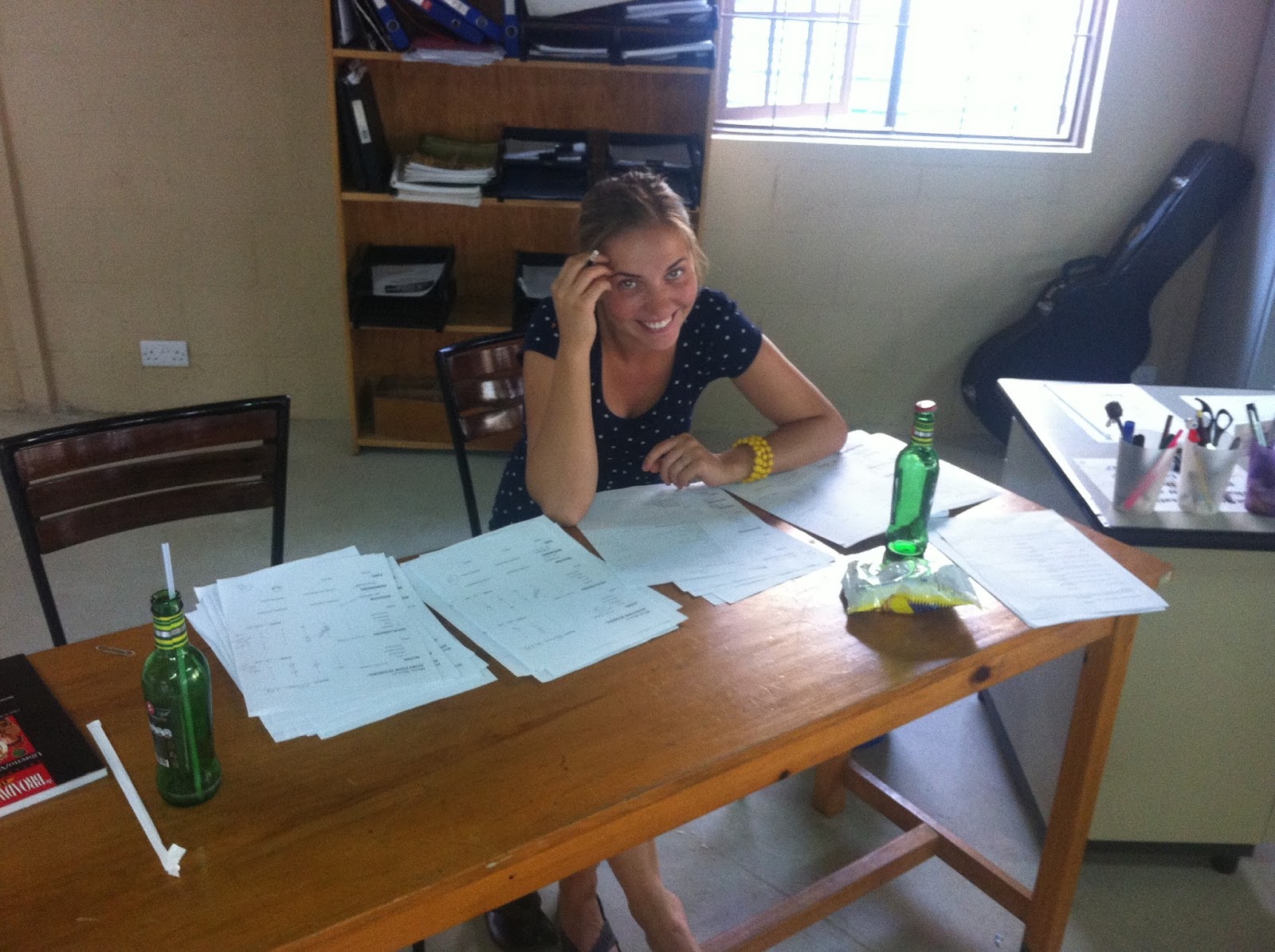
Reviewing auditions and making up the cast list for the school musical. 
Spend the day teaching --  giving devotions, prepping, grading, answering emails, calling parents, meeting with the secondary principal, meeting with my professional learning community of other teachers, meeting with student support services, meeting with parents, attending assemblies, writing report card comments, presenting lessons, giving detentions, planning field trips, creating rubrics, stapling things on a bulletin board, refereeing student arguments over the direction of the fan, etc., etc. Common annoyances include printer not working, photocopier backed up, Internet not working, or power going off.

12:10: Lunch. Once a week, it's my turn to get the lunches for the detention room.  That really breaks up the routine and keeps me on my toes.

More teaching.

Special days at school -- Wacky Day! 
3:00: Bell rings. "Stack your chairs, stack your chairs! See you tomorrow. Sam, did you give me that assignment? Whose bag is this? Hey, whose bag? Bye, having a good night!"

Staff meeting, possibly. Or a rehearsal for the school play. This includes running lines with students, listening to students sing the musical numbers, and giving my opinion on costumes made out of margarine containers, cereal boxes and expert use of a glue gun.

4:45 - 5:30: Grading, prepping for the next day.

Muwala interfering with a Saturday marking session ... 
5:30: Arrive back home. Feed the cat. Eat a patched-together dinner for one while watching a show. Lately, that show has been Call the Midwife, thanks to an understanding friend who sent me several seasons on a flash drive with my parents when they visited. Isaac and I often like to watch funny sitcoms when he's home, a fact that someone back in Canada found very surprising and, well, a little shallow. To be there. In Uganda. Watching TV?.... Sorry to disappoint.

Scrolling through Facebook, Pinterest and blogs ... Reading ... Sometimes grading *yech*

7:30: Turn on water heater.

8:00: Shower.

8:30: Call Isaac. Have deep conversations about paying the water bill and, could you pick up cat food and almond extract on your way home this weekend?

9:00: Lights out, bed. As much as I wish I was a more efficient human being, I need my sleep.

Once a week this routine is disrupted by attending our couples' Bible study (which, ironically, only I attend now as Isaac is in the village all week). This means I'm either going to eat at someone else's house, or hosting 25 people at my house. Sometimes I take a walk in the evening to pick up a few groceries, eyeing stray dogs warily and avoiding getting hit by bodas. About once or twice a week I hang out with one of my friends, either at her place or mine -- and my friends laugh at how I politely kick them out or politely begin to leave promptly around 8. I'm very clear -- I need my sleep. School night bedtime is not negotiable for this teacher.

This is not to complain. This is not to bore you (sorry). I love my job, I love teaching. I love teaching missionary kids and Ugandan kids that I believe will have a great influence in the future. I love supporting missionary families -- MAF pilots, orphanage directors, Bible school professors, church planters. Sometimes I feel a little restless to be out "on the front lines," sometimes I envy Isaac's life in the village (which, let me tell you, is also full of un-exciting hours -- hence his developed obsession with birdwatching), but I really feel that right now I am where God wants me to be. I believe that what I'm doing is building the Kingdom of God.

I'm sure many of you can relate -- whether your calling at the moment is raising kids or cooking at a church camp (why does that one spring to mind, I wonder?) or working at a bank or standing at a cash register or teaching at a college or cleaning people's teeth or setting up chairs before youth group. There's always the hum-drum of daily life, the mundane tasks that no one includes in a newsletter.

And it's the same over here, across the ocean in Uganda.


But sometimes the day-to-day is where I find the sweetest gems <3 


Tuesday, 24 March 2015

wounded

When I was in high school, I found a book called something along the lines of Twenty Things Every Christian Should Read. The book had excerpts from 20 great Christian thinkers -- an efficient way to pretend you had read more than you had. I bought the book, and read from Luther and Calvin and Lewis in bite-size pieces. But one excerpt that has stuck with me was by Julian of Norwich. I can't remember it very clearly, and I don't have the book here in Uganda to refer to, but I remember the powerful phrase -- she asked the Lord for "the wound of compassion."

A wound?

I'm slowly realizing how accurate the metaphor is. Compassion isn't a warm and fuzzy feeling. It's a wound, painful and bleeding. It's taking up a problem that isn't yours, attaching yourself to someone else's situation, allowing your own heart to be broken. I've seen compassion lead privileged people to fight for orphans in babies' homes. I've seen healthy people be driven to visit those in hospital. I've thought of my grandmother, recently deceased, who could have kept herself in a warm Christian cocoon but instead reached out to immigrants and inner-city kids. And the ultimate example: compassion drove Christ to the cross on our behalf, to reconcile us to God.

Last week, I met people who have tied themselves to one of the most heartbreaking causes I've seen yet in this country. Along with two friends, I accompanied the team at Sixty Feet on a visit to a children's prison outside of Kampala.

Children's prisons? What does that even mean? The first time I heard the term was a few months after arriving in Uganda in 2013. One of my students, it turned out, had actually been in one. The student had been picked up and loved by Sixty Feet, a Christian organization that reaches these kids who are literally locked up and forgotten. Ever since then I had wanted "to see" what a children's prison was, and what Sixty Feet was all about.

A children's prison houses, of course, convicted criminals who are under 18 years old. A few are 19 or 20, if their sentence slightly spilled over into adulthood. But there are more than just convicted criminals there. Child beggars, often from northern Uganda, are often picked up and dumped in these prisons when city officials "clean up" the streets. Sometimes kids who are hard to handle are also abandoned here.

I can't tell you the history of children's prisons. I can't explain in detail how they function. I don't understand why some of the kids from the north -- even ones whose families have been contacted by Sixty Feet -- can't legally be resettled or put in foster homes.

What I can tell you is what I saw in one afternoon. I'm sorry to readers who work in children's prisons and may shake their head at my limited understanding or possible misconceptions. I'm not qualified to explain the topic, but for many Canadian friends I've had an experience that is not possible for them. So all I can do is share my experience.

I saw very few adults. It was a little like Lord of the Flies. The only adult that is on the premises to care for the younger children (kids as young as 2 years old get dumped here) is someone that Sixty Feet actually hired. When I asked two boys if the kids are kind to each other, they laughed and said no. I can't imagine the pecking order in such a place, with no adults to curb the cruelty of troubled kids and teens.

I saw the dining area crowded with kids, singing and drumming with the visitors. I saw the Sixty Feet team, along with another visiting missionary, preach to the children in Luganda and in English. I saw peeling posters on the walls with Bible verses about the love of God. I saw a young man in prison give his testimony with thanksgiving and joy.

I saw the younger children curl up and fall asleep during the informal service. Different little girls grabbed at my hands, and I had the distinct feeling that I was being "claimed" by them. I sat with one little girl on a bench, her head in my lap, and she fell fast asleep. I tickled her arm gently, remembering how my mother used to do that for me, angry that she doesn't have a mother around to protect her.

I saw a little boy watch me with the girl on my lap. He tugged on my friend's hand and, without using any words, clearly communicated that he wanted her to do the same for him. Why did they fall asleep, I wondered, seeing another little one fast asleep on the back of a Sixty Feet worker. No bed time? Do they feel safe with us, safe enough to let their guard down and sleep?

I saw boys with shining black backs, no shirts on. "The ones with no shirts signify that they are new kids picked up off the street. Keeping them with no shirts on lets them be easily identified as being new, and they sleep in a separate area," I heard.

I saw that the majority of the older kids were boys. Many looked hardened and tough. And I looked at the little girls and I wondered what that meant for them.

I saw the area where the girls sleep. Few beds, all of them taken by bigger girls. "The kids here aren't kind to the small ones, they take the beds." And the little girls sleep in a huge room on cold concrete. I saw chickens on the beds, clucking and pecking at the pathetic mattresses. I saw chicken and goat feces smeared on the floor. Apparently, Compassion donated 300 mattresses last December. I didn't see one -- they have disappeared. I stood on the concrete, frantically calculating how many bunk beds we could fit in our spare room at home, but being told that these small kids from the north can't be resettled with families or put in foster homes even if they were available. A frustrated desire to keep these little girls safe when they lie down to sleep.

I saw the area where the boys sleep. More beds than the girls have, rooms divided based on hierarchy and seniority and punishment. I saw the solitary confinement cell, where new kids are sometimes put and runaways are beaten.

I didn't see love or care, or anyone protecting that little girl I carried who was so painfully thin, wrists like a little bird's. The only ones asking questions, knowing the kids by name, feeling frustration on their behalf were the Sixty Feet workers.

Afterward I went out for burgers with my two friends. Trying to process the day. But the reality didn't swell up and burst in me until later, crying hot tears and feeling angry and broken and powerless.

I didn't see any clear solutions. I didn't see a 1-2-3 step plan I could do.

The only avenues I can think of?

Check out Sixty Feet. Check out Emily Ryan's blog, one of the social workers for the organization who is bringing Christ into that prison.

Raise awareness. Read and question and feel pain and look at the photos my friend took while there.

Pray.

Whether it's about this or another issue God has placed on your heart, it's a worthwhile question to ask: Are we willing to be wounded?
An ironic sign in the boys' area.

The girls' sleeping room.

Chickens on one of the beds in the girls' quarters.


Isolation cell. 

Dining area. 

Kids praying during the service led by Sixty Feet volunteers.

My friend Sarah with one of the newly arrived boys. 

Where the little girls sleep ...  

Boys' sleeping area.